
Feedback is an important concept in electronic circuits, amplifiers, and control systems. It is the process of taking a portion of a system’s output and feeding it back to the input. Depending on the phase relationship, the feedback signal can either reinforce or oppose the input.
Feedback is broadly classified into positive feedback and negative feedback. Positive feedback reinforces the input and generally increases gain, while negative feedback opposes the input and generally improves stability, accuracy, and control.
Understanding the difference between positive feedback and negative feedback is essential for studying amplifiers, oscillators, operational amplifier circuits, and control systems. Their effects on gain, stability, bandwidth, distortion, sensitivity, and system response are different.
This article explains what feedback is, followed by positive and negative feedback, their operating principles, gain equations, phase relationships, stability, applications, advantages, and limitations, along with a comparison table and FAQs.
What is Feedback?
Feedback is the process of taking a fraction of a system’s output and returning it to the input through a feedback network. The feedback signal combines with the input and affects the overall system operation.
The amount of output returned to the input depends on the feedback network and is represented by the feedback factor, β. For an open-loop gain A and output voltage Vo:
Vf = βVo
Here:
- Vf = feedback voltage
- β = feedback factor
- Vo = output voltage
The phase relationship between the input and feedback signals determines whether the feedback is positive or negative.
How Does Feedback Work?
A basic feedback system consists of four elements:
- Input signal: Signal applied to the system.
- Amplifier or forward path: Processes and amplifies the input.
- Feedback network: Samples part of the output and returns it to the input.
- Output: Signal produced after feedback is applied.
Only a fraction of the output is normally fed back. This feedback changes the effective input, either increasing or reducing it depending on its phase relationship with the original input.
Related Articles:
- Difference Between Amplifier and Oscillator
- Different Types of Oscillators with Working and Applications
- Voltage Controlled Oscillator VCO Circuit Using 555 Timer IC
- RC Phase Shift Oscillator Circuit Working & Applications
- TDA2030 Audio Amplifier Circuit: Mono, Stereo and Bass Amplifier
- Wien Bridge Oscillator Circuit: Working and Applications
- Bipolar Junction Transistor (BJT) Biasing and Stabilization
Types of Feedback
Feedback in electronic and control systems is primarily classified into:
- Positive Feedback: Reinforces the input; also called regenerative feedback.
- Negative Feedback: Opposes the input; also called degenerative feedback.
In positive feedback, the feedback signal is added to the input, generally increasing gain. When the required loop-gain and phase conditions are satisfied, it can sustain oscillations and is widely used in oscillator circuits.
In negative feedback, the feedback signal is subtracted from the input. Although it reduces gain, it can improve stability, reduce distortion and sensitivity to parameter variations, and provide better circuit control.
Feedback in Amplifiers
Feedback is widely used in amplifiers to control their performance. For a basic feedback amplifier:
- A = open-loop gain
- β = feedback factor
- Aβ = loop gain
- Af = gain with feedback
For positive feedback:
Af = A / (1 − Aβ)
For negative feedback:
Af = A / (1 + Aβ)
These equations show the fundamental difference: positive feedback generally increases closed-loop gain, while negative feedback reduces gain but improves control and stability.
These equations assume the conventional feedback sign convention and scalar loop gain. In practical circuits, A and β can vary with frequency and include phase shifts.
Why is Feedback Important?
Feedback allows the behavior of an electronic or control system to be modified in a predictable way. Depending on its type, it can increase gain, generate oscillations, improve stability, reduce distortion, increase bandwidth, reduce parameter sensitivity, or improve regulation.
Positive feedback is important in oscillators because it reinforces signals and sustains oscillations. Negative feedback is widely used in amplifiers and control systems to improve stability and reduce sensitivity to circuit variations.
Therefore, identifying the type of feedback helps predict changes in gain, stability, frequency response, distortion, and overall system performance.
Positive Feedback
Positive feedback is a type of feedback in which a portion of the output signal is fed back to the input so that it is in phase with and reinforces the input signal. This increases the effective input to the amplifier or system.
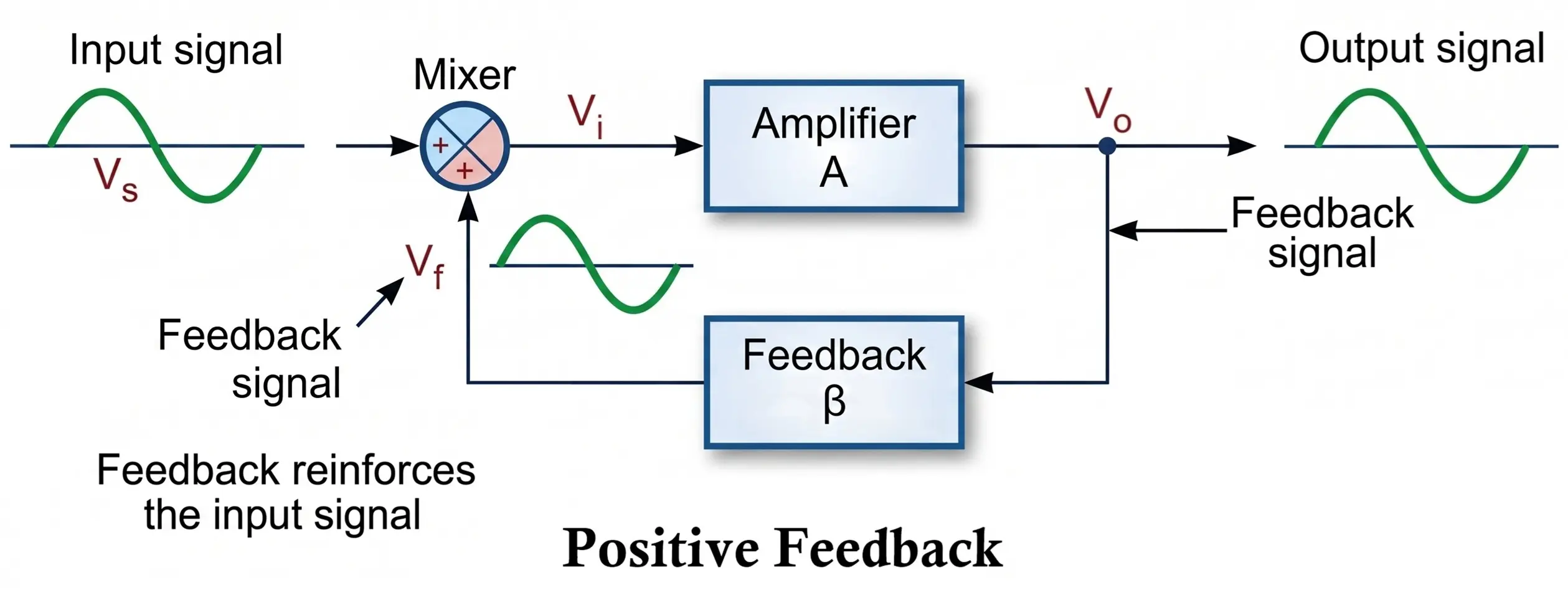
Positive feedback is also known as regenerative feedback. It is commonly used where signal reinforcement, switching, or sustained oscillation is required, including oscillators, Schmitt triggers, regenerative circuits, and comparator circuits.
Unlike negative feedback, positive feedback generally increases overall gain. Excessive feedback can cause instability, while properly phased feedback with the required loop-gain condition can sustain oscillations.
Basic Principle of Positive Feedback
Consider an amplifier with open-loop gain A. A portion of its output is returned to the input through a feedback network. If the output voltage is Vo and the feedback factor is β:
Vf = βVo
Since positive feedback adds the feedback signal to the input:
Vi = Vs + Vf
Vi = Vs + βVo
The amplifier output is:
Vo = AVi
Thus, the feedback signal reinforces the amplifier input.
Phase Relationship in Positive Feedback
The defining characteristic of positive feedback is that the feedback signal reaches the input with the appropriate phase to reinforce the original input. In the simplest case, the input and feedback signals are in phase.
For a conventional single-loop system, the total loop phase must be an integer multiple of 360°:
0° or 360° (or an integer multiple of 360°)
This phase condition is particularly important in oscillators, where the feedback signal must return with the correct phase to sustain oscillations.
Positive Feedback in an Amplifier
Consider a non-inverting amplifier with open-loop gain A and feedback factor β. Since positive feedback adds the feedback voltage:
Vi = Vs + βVo
Since Vo = AVi:
Vo = A(Vs + βVo)
Rearranging:
Vo(1 − Aβ) = AVs
Therefore, the voltage gain with positive feedback is:
Af = Vo/Vs = A/(1 − Aβ)
Here, Af is the closed-loop gain.
Effect of Positive Feedback on Gain
The gain equation is:
Af = A/(1 − Aβ)
Increasing the feedback factor β reduces the denominator (1 − Aβ), causing the closed-loop gain to increase within the applicable operating conditions.
The quantity Aβ is the loop gain. As it approaches unity:
Aβ → 1
the denominator approaches zero:
1 − Aβ → 0
In the ideal model, the gain becomes very large. In a real circuit, saturation, nonlinearities, frequency response, and losses limit the output.
Positive Feedback and Oscillation
Positive feedback is fundamental to the generation of electrical oscillations. It returns part of the output to the input with the required phase and magnitude, allowing an oscillator to produce a periodic output without a continuous external input.
For sustained oscillation, the idealized Barkhausen criterion is:
|Aβ| = 1
∠Aβ = 0° or 360° (modulo 360°)
The first condition specifies the loop-gain magnitude, while the second specifies the phase condition.
If the loop gain is initially greater than unity, the oscillation amplitude tends to grow. Nonlinear effects in a practical circuit then limit the amplitude, bringing the effective loop gain toward the condition for sustained oscillation.
Positive feedback is therefore used in Wien bridge, RC phase-shift, LC, and crystal oscillators.
Characteristics of Positive Feedback
- Reinforces the input signal.
- Also called regenerative feedback.
- Generally increases closed-loop gain.
- Closed-loop gain: Af = A/(1 − Aβ).
- Can produce and sustain oscillations.
- Can create hysteresis and rapid switching.
- Useful for regeneration, switching, and oscillation.
- Uncontrolled feedback can cause instability, saturation, or unwanted oscillations.
Advantages of Positive Feedback
- Increases gain: Can substantially increase effective closed-loop gain.
- Enables oscillation: Provides regenerative action for oscillator circuits.
- Fast switching: Can rapidly drive circuits between operating states.
- Provides hysteresis: Establishes distinct switching thresholds in Schmitt triggers and comparators.
- Signal regeneration: Can reinforce weak transitions or signals in suitable circuits.
Limitations of Positive Feedback
- Reduced stability: Excessive feedback can make a system unstable.
- Unwanted oscillations: Improper loop conditions can cause oscillation.
- Gain sensitivity: Gain becomes highly sensitive as loop gain approaches unity.
- Distortion and saturation: Excessive regeneration can drive active devices into nonlinear operation.
- Poor gain control: It is generally unsuitable for precise, stable amplification or regulation.
Applications of Positive Feedback
Positive feedback is used where signal reinforcement or regeneration is required, including:
- Oscillators: RC, LC, crystal, and other oscillator circuits.
- Schmitt triggers: Creates hysteresis and improves noise immunity.
- Regenerative receivers: Increases effective amplification and selectivity.
- Comparators: Provides hysteresis and prevents unwanted switching near the threshold.
- Switching circuits: Enables faster transitions and distinct logic states.
- Timing circuits: Supports repeated transitions and periodic waveform generation.
Thus, positive feedback is primarily a controlled regeneration technique. It enables oscillation, hysteresis, rapid switching, and signal regeneration, but improper control can lead to instability and unwanted oscillations.
Negative Feedback
Negative feedback is a type of feedback in which a portion of the output signal is fed back to the input so that it opposes the original input signal. The feedback signal is therefore subtracted from the input, reducing the effective input applied to the amplifier or system.
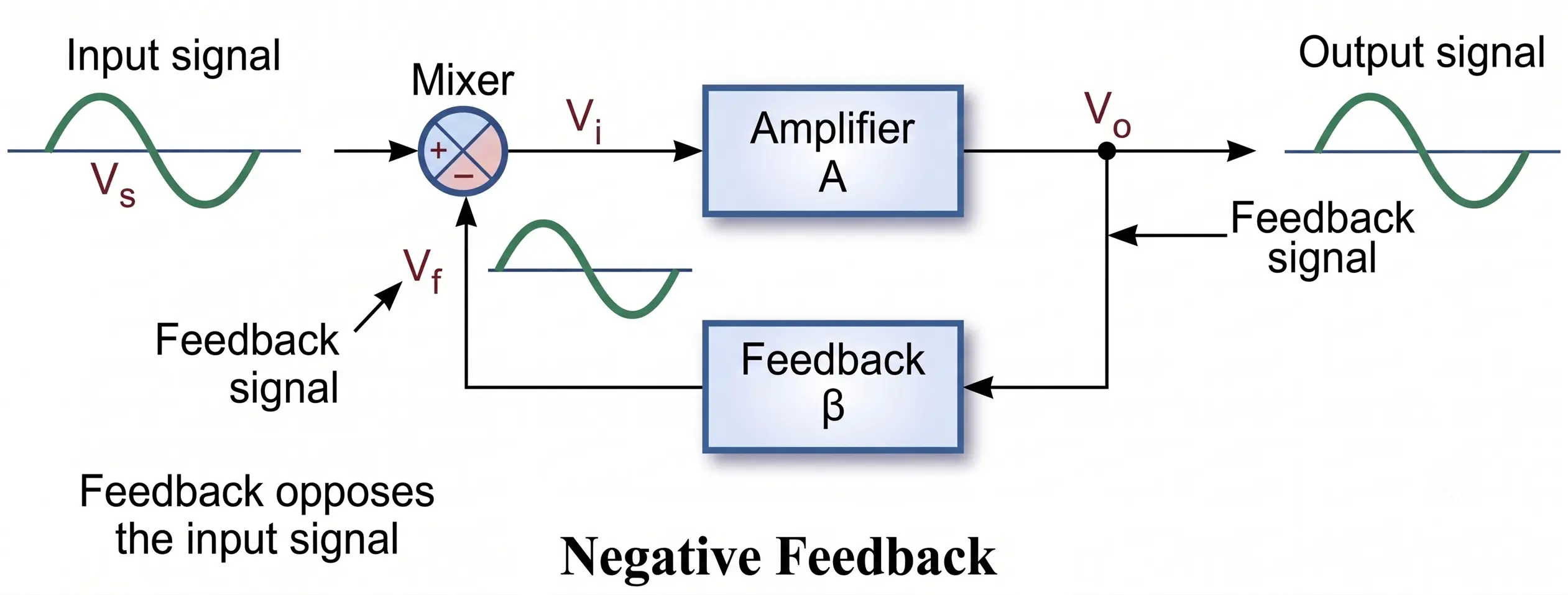
Negative feedback is also known as degenerative feedback. It is widely used in electronic amplifiers and control systems because it can improve stability, accuracy, bandwidth, linearity, and resistance to parameter variations.
Although negative feedback reduces amplifier gain, this reduction is often accepted for improved and more predictable performance.
Basic Principle of Negative Feedback
Consider an amplifier with open-loop gain A. A fraction of its output is returned to the input through a feedback network. If the output voltage is Vo and the feedback factor is β, the feedback voltage is:
Vf = βVo
Since the feedback voltage opposes the input:
Vi = Vs − Vf
Vi = Vs − βVo
The amplifier output is:
Vo = AVi
Thus, negative feedback reduces the effective input and provides the error-correcting action responsible for its useful characteristics.
Phase Relationship in Negative Feedback
The defining feature of negative feedback is that the feedback signal reaches the input with the appropriate phase to oppose the original input. In the simplest voltage-feedback case, it is effectively 180° out of phase with the input at the summing point.
More generally, negative feedback depends on the overall loop action, determined by both the amplifier and feedback network. For a conventional single-loop system, the corresponding phase relationship is:
180° (modulo 360°)
Negative Feedback in an Amplifier
Consider an amplifier with open-loop gain A and feedback factor β. The effective input is:
Vi = Vs − βVo
Since Vo = AVi:
Vo = A(Vs − βVo)
Rearranging:
Vo(1 + Aβ) = AVs
Therefore, the voltage gain with negative feedback is:
Af = Vo/Vs = A/(1 + Aβ)
Here, Af is the closed-loop gain.
Effect of Negative Feedback on Gain
The closed-loop gain is:
Af = A/(1 + Aβ)
Since 1 + Aβ is greater than unity, the closed-loop gain is lower than the open-loop gain A. This reduction is accepted because negative feedback improves other amplifier characteristics.
When the loop gain Aβ ≫ 1:
Af ≈ 1/β
Thus, the closed-loop gain is primarily determined by the feedback network and becomes less sensitive to variations in the amplifier’s internal parameters.
How Negative Feedback Improves Stability
Negative feedback reduces the sensitivity of amplifier gain to circuit-parameter variations. Changes caused by transistor characteristics, temperature, supply voltage, component tolerances, and aging have less effect on the closed-loop gain.
The sensitivity is approximately:
S = 1/(1 + Aβ)
As Aβ increases, sensitivity decreases. Negative feedback therefore reduces, rather than completely eliminates, the effect of forward-path variations.
Effect of Negative Feedback on Bandwidth
Negative feedback can increase the usable bandwidth of an amplifier while reducing its midband gain. For a single-pole amplifier model:
Gain × Bandwidth ≈ Constant
Thus, reducing closed-loop gain can extend the usable frequency range. This is one reason negative feedback is widely used in wideband amplifiers and operational amplifier circuits.
Effect of Negative Feedback on Distortion and Noise
Negative feedback can reduce nonlinear distortion by correcting errors produced by the forward amplifier. For sufficiently large loop gain, the approximate correction factor is related to:
1 + Aβ
Higher loop gain generally provides greater correction, subject to frequency response, stability, and available gain.
Negative feedback can also reduce some internally generated noise, but it does not eliminate all noise. Noise introduced after the feedback sensing point or within the feedback network may not be corrected in the same way.
Negative Feedback and Stability
Negative feedback generally improves stability when the loop is properly designed. However, it does not automatically guarantee stability.
At higher frequencies, phase shifts in the amplifier and feedback network can make the loop effectively regenerative. If the loop gain remains sufficiently high, this can cause peaking, ringing, or oscillation.
Practical feedback amplifiers therefore require adequate phase margin, gain margin, and frequency compensation where necessary.
Characteristics of Negative Feedback
- The feedback signal opposes the input.
- It is also known as degenerative feedback.
- Closed-loop gain is generally lower than open-loop gain.
- Af = A/(1 + Aβ) for the conventional model.
- Improves gain stability and predictability.
- Reduces sensitivity to amplifier-parameter variations.
- Can reduce nonlinear distortion.
- Can increase usable bandwidth.
- Improves linearity and helps control frequency response.
- Can reduce certain disturbances and errors.
- Improper phase response can cause instability.
Advantages of Negative Feedback
- Improved stability: Reduces sensitivity of closed-loop gain to amplifier variations.
- Reduced distortion: Improves amplifier linearity.
- Increased bandwidth: Can extend the useful frequency range.
- Better gain control: Makes closed-loop gain more predictable.
- Reduced parameter sensitivity: Lessens the effects of temperature and transistor variations.
- Improved overall performance: Provides better control of multiple amplifier characteristics.
Limitations of Negative Feedback
- Reduced gain: Closed-loop gain is lower than open-loop gain.
- Design complexity: Requires additional feedback-network considerations.
- Potential instability: Poor phase response can cause ringing or oscillation.
- Frequency-dependent performance: Feedback effectiveness decreases as loop gain falls at higher frequencies.
- Feedback-network limitations: The network affects gain, frequency response, loading, and noise performance.
Applications of Negative Feedback
Negative feedback is widely used where stable, accurate, and predictable operation is required, including:
- Amplifiers: Audio, voltage, power, and operational amplifiers.
- Operational amplifiers: Sets closed-loop gain and controls circuit behavior.
- Voltage regulators: Corrects deviations from the reference voltage.
- Temperature control: Maintains the desired temperature.
- Speed control: Maintains the desired motor speed.
- Automatic control: Reduces error between desired and actual output.
- Instrumentation: Provides stable and accurate signal conditioning.
Negative feedback sacrifices some gain to improve stability, linearity, bandwidth, and control. This makes it a fundamental technique in practical amplifiers and control systems.
Difference Between Positive Feedback and Negative Feedback
The main difference between positive feedback and negative feedback is how the feedback signal affects the input. Positive feedback reinforces the input, while negative feedback opposes it. This difference affects gain, stability, distortion, bandwidth, and applications.
| Parameter | Positive Feedback | Negative Feedback |
|---|---|---|
| Basic Principle | Feedback reinforces the input. | Feedback opposes the input. |
| Other Name | Regenerative feedback | Degenerative feedback |
| Effect on Gain | Generally increases closed-loop gain. | Generally decreases closed-loop gain. |
| Closed-Loop Gain | Af = A/(1 − Aβ) | Af = A/(1 + Aβ) |
| Phase Relationship | Acts constructively with the input. | Acts oppositely to the input. |
| Stability | Generally reduces stability. | Generally improves stability. |
| Oscillation | Can produce or sustain oscillations. | Normally suppresses unwanted oscillations. |
| Distortion | May increase nonlinear distortion. | Generally reduces nonlinear distortion. |
| Bandwidth | Not normally used to increase amplifier bandwidth. | Can increase usable amplifier bandwidth. |
| Linearity | Generally not preferred for linear amplification. | Improves amplifier linearity. |
| Sensitivity | Generally increases near the oscillation condition. | Reduces sensitivity to parameter variations. |
| Primary Purpose | Regeneration, oscillation, hysteresis, and switching. | Stable amplification, error correction, and control. |
| Common Applications | Oscillators, Schmitt triggers, regenerative receivers, and switching circuits. | Amplifiers, op-amps, voltage regulators, instrumentation, and control systems. |
- Feedback Direction: Positive feedback reinforces the input, while negative feedback opposes it.
- Gain: Positive feedback generally increases gain, whereas negative feedback decreases gain and provides better gain control.
- Stability: Positive feedback can reduce stability and cause oscillation, while negative feedback generally improves stability.
- Distortion and Linearity: Negative feedback reduces distortion and improves linearity. Excessive positive feedback may increase nonlinear operation.
- Applications: Positive feedback is used in oscillators, Schmitt triggers, hysteresis, and switching circuits. Negative feedback is used in amplifiers, op-amps, voltage regulators, instrumentation, and control systems.
Positive feedback is suitable for regeneration and oscillation, while negative feedback is preferred for stable, accurate, and linear operation.
Conclusion
Understanding the difference between positive feedback and negative feedback is important in electronic circuits, amplifiers, oscillators, and control systems. Both feed part of the output back to the input, but their effects are opposite.
Positive feedback or regenerative feedback reinforces the input, increasing regeneration and potentially causing oscillation. It is commonly used in oscillators, Schmitt triggers, hysteresis, and switching circuits.
Negative feedback or degenerative feedback opposes the input. It generally reduces gain but improves stability, linearity, bandwidth, distortion, and gain consistency. It is widely used in amplifiers, op-amp circuits, voltage regulators, instrumentation, and control systems.
Thus, positive feedback is preferred for regeneration and oscillation, while negative feedback is preferred for stable, accurate, and linear operation. The appropriate choice depends on the required circuit performance.
FAQs on Positive Feedback and Negative Feedback
What is the difference between positive feedback and negative feedback?
Positive feedback reinforces the input and can increase gain or cause oscillation. Negative feedback opposes the input and generally improves stability, linearity, and gain control.
What is positive feedback?
Positive feedback or regenerative feedback returns part of the output to reinforce the input. It is commonly used in oscillators, Schmitt triggers, and hysteresis circuits.
What is negative feedback?
Negative feedback or degenerative feedback returns part of the output to oppose the input. It is widely used in amplifiers and control systems to improve stability and linearity.
What is the gain formula for positive feedback?
Af = A/(1 − Aβ)
Here, A is the open-loop gain and β is the feedback factor.
What is the gain formula for negative feedback?
Af = A/(1 + Aβ)
Here, A is the open-loop gain and β is the feedback factor.
Which feedback provides better stability?
Negative feedback generally provides better stability by opposing changes and reducing sensitivity to variations in amplifier parameters.
Why is positive feedback used in oscillators?
Positive feedback reinforces the signal. When the required loop-gain and phase conditions are satisfied, this regenerative action sustains oscillations.
What is the Barkhausen criterion?
For an ideal feedback oscillator, the loop gain must satisfy:
|Aβ| = 1
∠Aβ = 0° or 360°
Does negative feedback reduce distortion and increase bandwidth?
Yes. Properly applied negative feedback can reduce nonlinear distortion and increase usable bandwidth, although the actual improvement depends on the circuit and available loop gain.
Which feedback is commonly used in amplifiers?
Negative feedback is commonly used because it provides more stable gain, lower distortion, improved linearity, and predictable operation. Positive feedback is used when regeneration or oscillation is required.
Different Types of Oscillators with Working and Applications
Voltage Controlled Oscillator VCO Circuit Using 555 Timer IC
TDA2030 Audio Amplifier Circuit: Mono, Stereo and Bass Amplifier
