
Learn how to decode a resistor color code. If you’ve ever grabbed a handful of resistors and wondered why there isn’t a number printed on the side, you’re not alone. Instead of text, most through-hole resistors use a simple color-code system: four colored bands wrapped around the body that tell you everything you need to know about the resistor’s value and accuracy. The system has been around for decades, yet it remains one of the most common ways to identify resistors today.
At first glance, this can feel like decoding a secret language. Once you understand the logic behind it, though, reading a resistor becomes as quick as reading a label. This guide walks through exactly how the color code system works, how to read 4-band, 5-band and 6-band resistors, and how to double-check your reading so you’re not caught out by a bad guess. Use this standard Resistor Color Code Calculator to find values of your all 3, 4, 5 and 6 band resistors.
What Is a Resistor Color Code?
A resistor color code is a standardized way of encoding a resistor’s value using colored bands instead of printed numbers. Each color stands in for a digit, and the bands are read in a specific order to build up the full value.
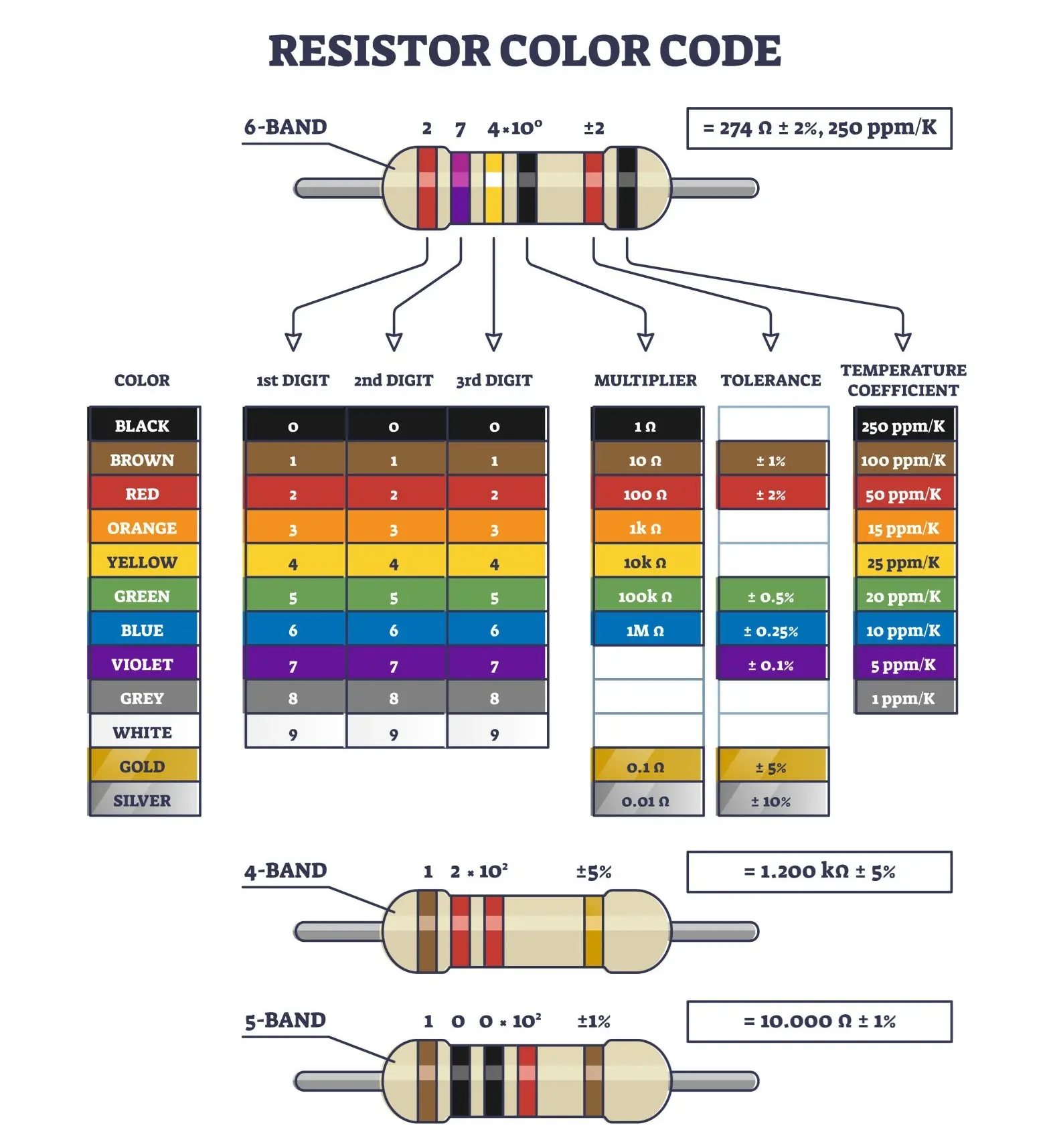
Depending on the resistor, the bands typically represent:
- Significant digits: the core numbers that make up the value
- Multiplier: how many zeros to add to those digits
- Tolerance: how far the actual resistance may vary from the stated value
For example, a resistor with brown, black, red, gold bands reads as 1, 0, ×100, with ±5% tolerance giving a final value of 1 kΩ ±5%.
One quick orientation tip before you start: the tolerance band is usually spaced slightly farther from the rest. That gap is what tells you which end to start reading from, start from the tightly grouped bands, not the isolated one.
Related Articles:
- 4,5,6 Band Resistor Color Code Calculator
- Types of Resistors with Symbol, Classification and Applications
- Fusible Resistor Construction, Working, Types and Applications
- Wire Wound Resistor Construction, Working, Types & Applications
- Carbon Composition Resistor Construction, Working & Applications
- Carbon Film Resistor Construction, Working, Types & Applications
- Metal Film Resistor Construction, Working, Types and Applications
- Metal Oxide Resistor Construction, Working, Types & Applications
- SMD Resistors Construction, Working, Types and Applications
- Rheostat Construction, Working, Types and Applications
- Trimmer Resistor Construction, Working, Types and Applications
Resistor Color Code Chart
Each color corresponds to a fixed digit and multiplier:
| Color | Digit | Multiplier |
| Black | 0 | ×1 |
| Brown | 1 | ×10 |
| Red | 2 | ×100 |
| Orange | 3 | ×1,000 |
| Yellow | 4 | ×10,000 |
| Green | 5 | ×100,000 |
| Blue | 6 | ×1,000,000 |
| Violet | 7 | ×10,000,000 |
| Gray | 8 | ×100,000,000 |
| White | 9 | ×1,000,000,000 |
| Gold | — | ×0.1 |
| Silver | — | ×0.01 |
A quick note on gold and silver: they can play two different roles depending on where they sit. As the multiplier band (×0.1 and ×0.01), they show up on low-value resistors commonly below 10 Ω, such as current-sense resistors. As the final band, they indicate tolerance instead. Position on the resistor is what tells you which one you’re looking at.
Tolerance is read separately, using its own set of colors:
| Color | Tolerance |
| Brown | ±1% |
| Red | ±2% |
| Gold | ±5% |
| Silver | ±10% |
How to Read a 4-Band Resistor
Four-band resistors are the type you’ll see most often in beginner kits and general-purpose circuits. The bands, in order, represent:
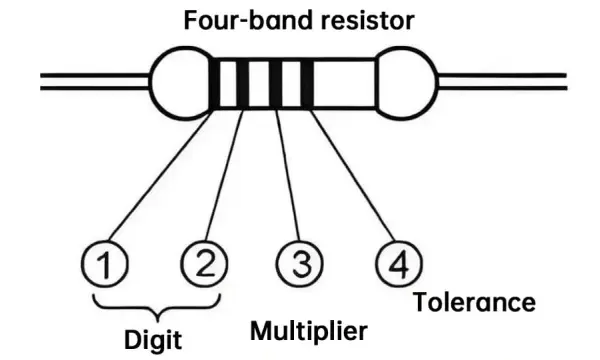
- First significant digit
- Second significant digit
- Multiplier
- Tolerance
Band positions on a 4-band resistor: two digits, a multiplier, and tolerance.
Example: Red, Violet, Orange, Gold
- Digits: Red (2), Violet (7) → 27
- Multiplier: Orange → ×1,000
- Value: 27 × 1,000 = 27,000 Ω
Final: 27 kΩ ±5%
Example: Brown, Black, Red, Gold
- First two digits: Brown (1), Black (0) → 10
- Multiplier: Red → ×100
- Value: 10 × 100 = 1,000 Ω
- Tolerance: Gold → ±5%
Final reading: 1 kΩ ±5%
That last part matters more than beginners usually expect a “1 kΩ” resistor with ±5% tolerance could measure anywhere from 950 Ω to 1050 Ω on a meter and still be within spec.
How to Read a 5-Band Resistor
Five-band resistors are used when a circuit needs tighter precision. Instead of two significant digits, they use three, which allows for finer resolution:
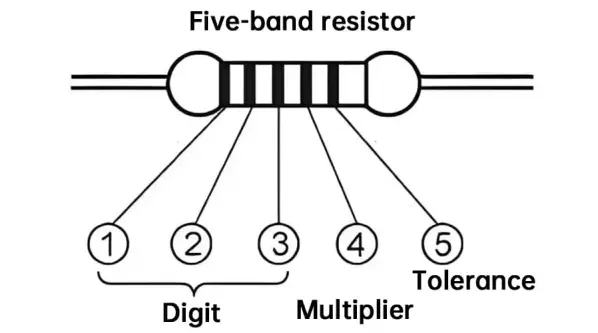
- First significant digit
- Second significant digit
- Third significant digit
- Multiplier
- Tolerance
Band positions on a 5-band resistor: three digits, a multiplier, and tolerance.
Example: Green, Blue, Black, Brown, Brown
- Digits: Green (5), Blue (6), Black (0) → 560
- Multiplier: Brown → ×10
- Value: 560 × 10 = 5,600 Ω
Final: 5.6 kΩ ±1%
Example: Brown, Black, Black, Red, Brown
- First three digits: Brown (1), Black (0), Black (0) → 100
- Multiplier: Red → ×100
- Value: 100 × 100 = 10,000 Ω
- Tolerance: Brown → ±1%
Final reading: 10 kΩ ±1%
Because the tolerance band is so much tighter on 5-band resistors, they’re the go-to choice in precision circuits, audio equipment, sensor reference voltages, and measurement instruments, where even a small deviation can throw off performance.
How to Read a 6-Band Resistor
Six-band resistors are designed for applications that require not only precise resistance and tolerance but also a specified temperature coefficient. They use three significant digits, a multiplier, a tolerance band, and a sixth band that indicates how much the resistance changes with temperature.
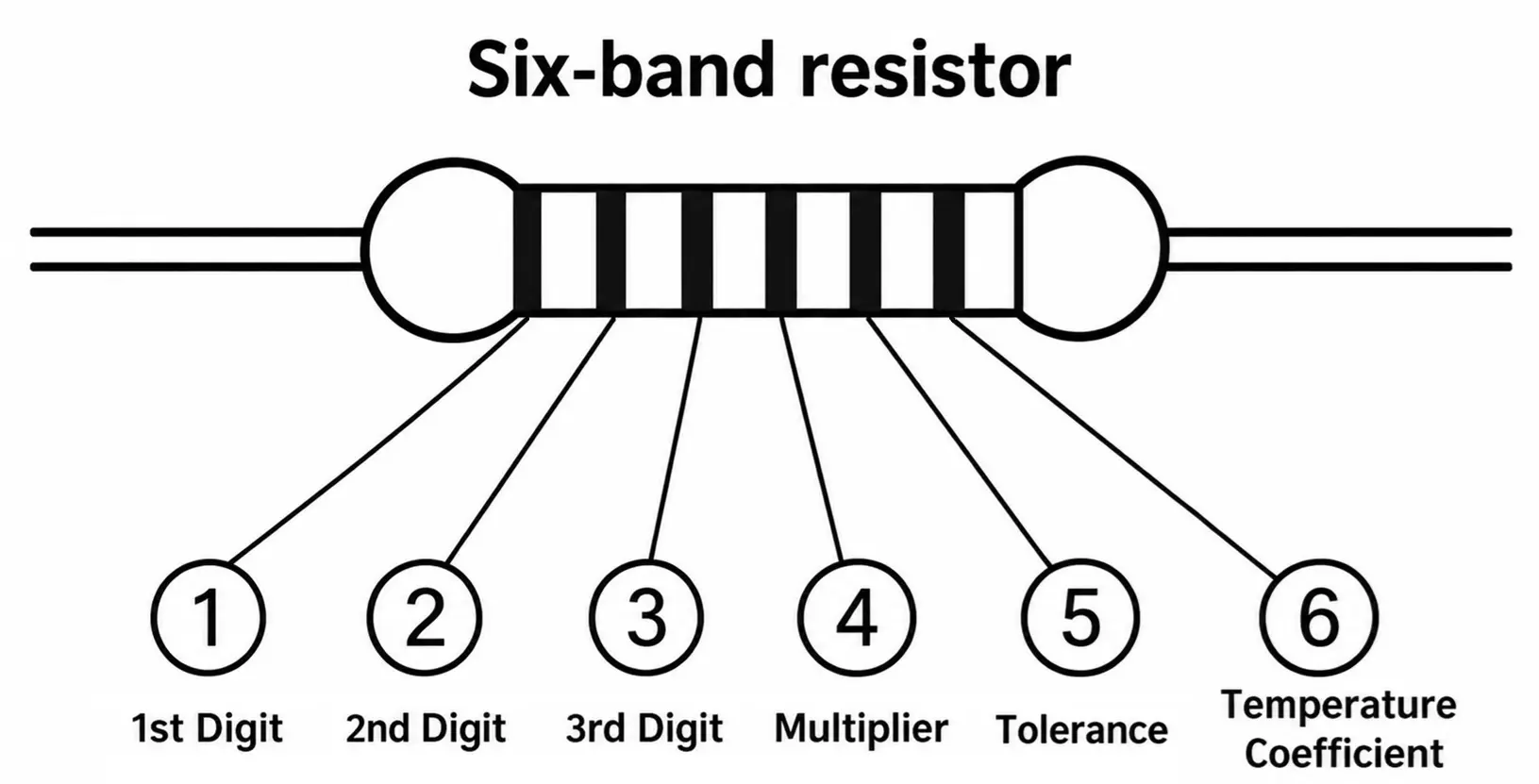
- First significant digit
- Second significant digit
- Third significant digit
- Multiplier
- Tolerance
- Temperature coefficient (ppm/°C)
Band positions on a 6-band resistor: three significant digits, a multiplier, tolerance, and temperature coefficient.
Example: Green, Blue, Black, Brown, Brown, Red
- Digits: Green (5), Blue (6), Black (0) → 560
- Multiplier: Brown → ×10
- Resistance: 560 × 10 = 5,600 Ω
- Tolerance: Brown → ±1%
- Temperature coefficient: Red → 50 ppm/°C
Final: 5.6 kΩ ±1%, 50 ppm/°C
Example: Brown, Black, Black, Red, Brown, Brown
- First three digits: Brown (1), Black (0), Black (0) → 100
- Multiplier: Red → ×100
- Resistance: 100 × 100 = 10,000 Ω
- Tolerance: Brown → ±1%
- Temperature coefficient: Brown → 100 ppm/°C
Final: 10 kΩ ±1%, 100 ppm/°C
What Does the Sixth Band Mean?
The sixth band specifies the resistor’s temperature coefficient. This value describes the change in resistance for every 1°C change in temperature.
For example, a resistor marked 50 ppm/°C changes its resistance by approximately 50 parts per million for every 1°C temperature change.
For a 10 kΩ resistor with a 50 ppm/°C temperature coefficient:
ΔR = R × TC × ΔT
For a 10°C temperature increase:
ΔR = 10,000 × 50 × 10 / 1,000,000 = 5 Ω
Therefore, the resistance would change by approximately 5 Ω over a 10°C temperature increase, assuming the temperature coefficient remains applicable over that range.
Common Temperature Coefficient Colors
| Sixth Band Color | Temperature Coefficient |
|---|---|
| Brown | 100 ppm/°C |
| Red | 50 ppm/°C |
| Orange | 15 ppm/°C |
| Yellow | 25 ppm/°C |
| Blue | 10 ppm/°C |
| Violet | 5 ppm/°C |
Lower temperature-coefficient values generally indicate better resistance stability as temperature changes. This is particularly important in precision measurement and reference circuits.
Because six-band resistors specify resistance, tolerance, and temperature stability, they are commonly used in precision instrumentation, sensor circuits, measurement equipment, audio electronics, industrial control systems, and other applications where resistance must remain stable over changing operating temperatures.
Common Mistakes to Watch For
Reading from the wrong end. This is the single most common error. Always locate the wider gap before the tolerance band and start reading from the opposite side, reading backward will give you a completely different, and wrong, value.
Mixing up similar colors. Brown, red, and orange can look nearly identical under poor lighting or on small components. If a reading seems off, that’s usually the first thing to double-check.
Ignoring tolerance. The calculated value from the bands isn’t a guarantee — it’s a midpoint. A resistor’s tolerance band tells you the real-world range you should expect when you measure it, and that range matters when you’re troubleshooting a circuit that isn’t behaving as designed.
Double-Checking Your Reading
Manually decoding bands is a genuinely useful skill, it’s fast, it doesn’t need any equipment, and it’s often the quickest way to sort a mixed bin of components. But it’s also easy to mis-read a color under bad lighting, transpose two digits, or miscount a band on a 5-band resistor, especially when you’re working through a pile of them.
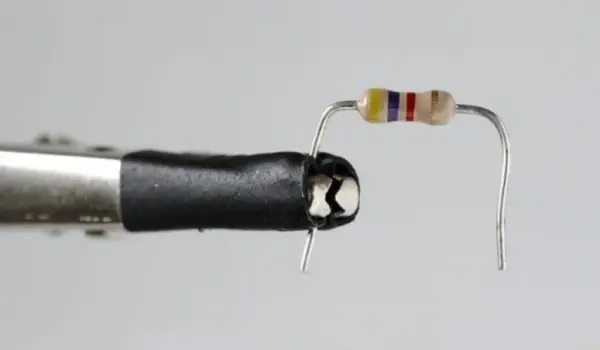
When a reading matters for a repair or a design, checking it against a probe reading (or a calculator) takes the guesswork out.
When you want a second opinion on a reading or you’re working with 5-band resistors where the extra digit adds room for error, it helps to cross-check your manual calculation against a dedicated tool rather than second-guessing yourself. NextPCB’s 5-band resistor color code calculator is a straightforward way to do this: enter the band colors you see, and it works out the value and tolerance for you, so you can confirm your own reading or catch a mistake before it ends up in a design or a repair.
Reading resistor color codes manually is a useful habit to build, regardless of your experience level. Even if you read color codes every day, it’s still worth taking a moment to verify the value when precision matters.
Types of Resistors with Symbol, Classification and Applications
Fusible Resistor Construction, Working, Types and Applications
Wire Wound Resistor Construction, Working, Types and Applications
Carbon Composition Resistor Construction, Working & Applications
Carbon Film Resistor Construction, Working, Types and Applications
Metal Film Resistor Construction, Working, Types and Applications
Metal Oxide Resistor Construction, Working, Types and Applications
Trimmer Resistor Construction, Working, Types and Applications
