
Have you developed an innovative PCB, built a robotics project, designed an IoT device, or created a hardware solution that deserves a wider audience? Now is an opportunity to put your engineering skills to the test.
The PCBWay 9th Project Design Contest 2026 invites engineers, electronics enthusiasts, students, makers, and hardware innovators to showcase their original projects to a global community. With five project themes, cash prizes of up to $2,000, and hardware rewards including an NVIDIA Jetson Orin Nano Super Developer Kit, the competition offers an opportunity to turn your technical creativity into a recognized achievement.
Whether you specialize in embedded systems, power electronics, robotics, PCB design, or mechanical engineering, there is a category for your ideas. Even projects that do not fit neatly into a particular engineering discipline can be submitted under the Open Theme.
Here is everything you need to know about the competition, including the submission deadline, project categories, prizes, judging criteria, and steps to enter.
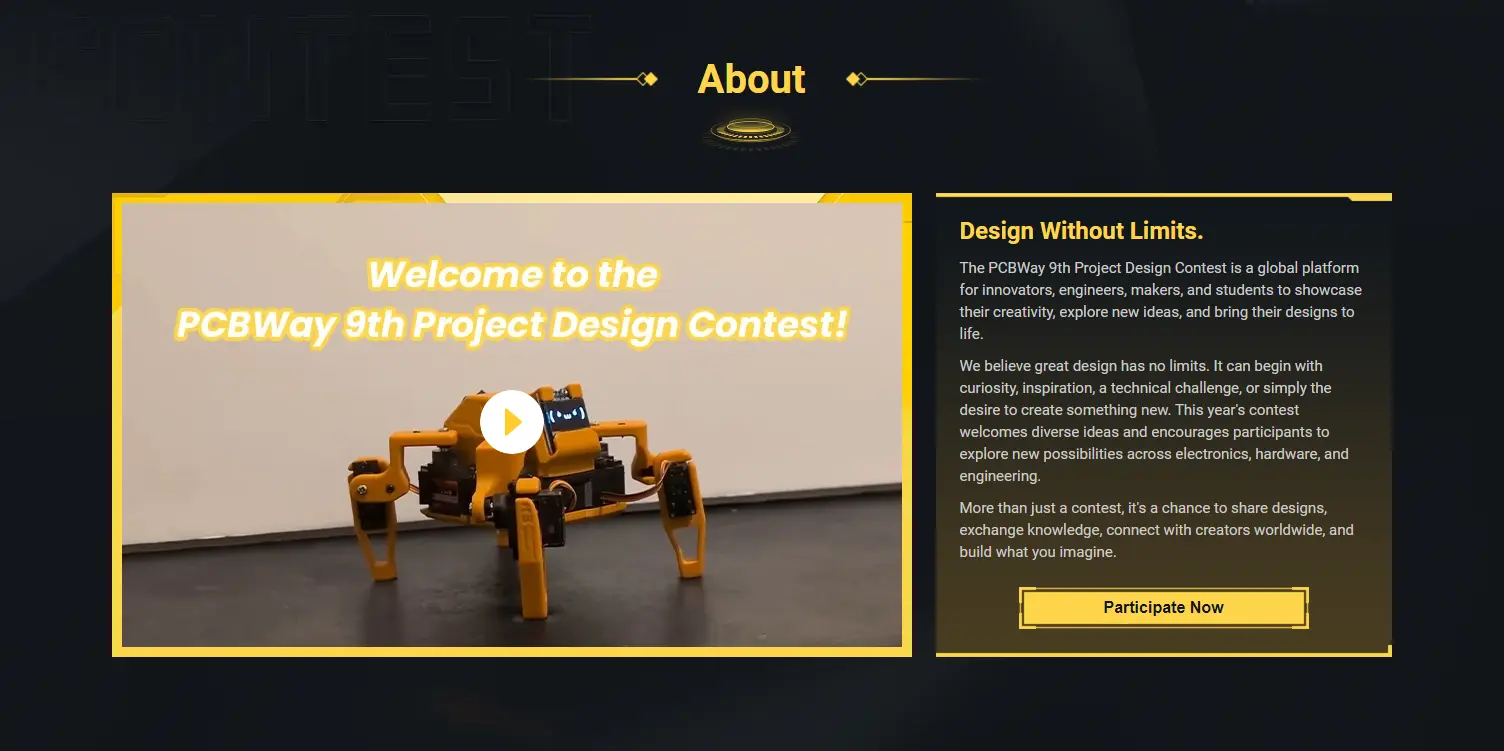
Ready to participate? Visit the official PCBWay 9th Project Design Contest page to explore the contest and submit your project.
Related Articles:
- Raspberry Pi 5 Pinout, Specifications and Pricing
- Raspberry Pi 4 Pinout, Specifications and Applications
- ESP32 Air Quality Monitoring with BME680
- ESP32 Weather Station with BMP280/BME280
- Water Quality Monitoring with TDS Sensor, ESP32 and Arduino
- Arduino UNO R4 Minima and Wi-Fi: Pinout and Specifications
- Raspberry Pi Compute Module 5 IO Board Explained
- Raspberry Pi Compute Module 5 (CM5) Explained
- Raspberry Pi Media Server
- 5 Raspberry Pi AI Projects You Can Build with One API Key
PCBWay 9th Project Design Contest 2026: Key Details
The contest is designed to bring creative hardware projects into the spotlight. Participants can submit original work individually or as a team, share their designs with other makers, and compete for cash, PCBWay coupons, and useful development hardware.
| Contest Detail | Information |
|---|---|
| Competition | PCBWay 9th Project Design Contest 2026 |
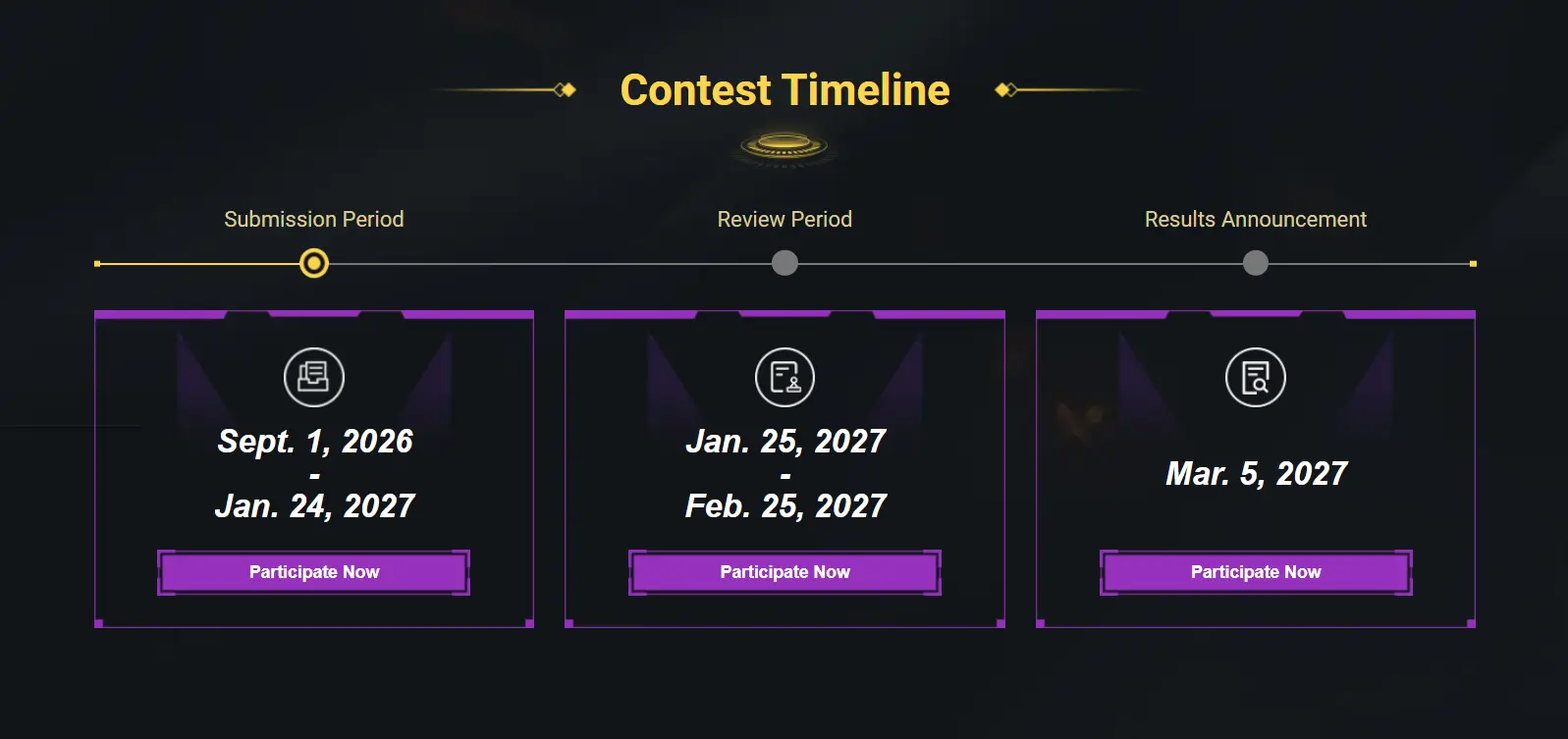
| Submission period | September 1, 2026 – January 24, 2027 |
| Review period | January 25 – February 25, 2027 |
| Results announcement | March 5, 2027 |
| Project themes | Edge AI & IoT, Robotics, Power, Open Theme, and Mechanical |
| Top cash prize | $2,000 |
| Participation format | Individual or team submissions |
| Official contest page | View contest details |
Submission deadline: January 24, 2027. Your project must meet the contest’s originality and submission requirements and be submitted within the official submission period.
What Makes the PCBWay Project Design Contest Worth Entering?
Engineering innovation is not limited to commercial products or professional laboratories. A carefully designed circuit board, a useful automation system, or a clever solution to an everyday problem can demonstrate just as much ingenuity.
The PCBWay 9th Project Design Contest encourages participants to present their work, explain the engineering behind it, and share their ideas with a broader technical community.
- Compete for valuable prizes: Winning entries can receive cash awards, PCBWay coupons, and development hardware.
- Showcase your engineering skills: Present your circuit designs, embedded software, prototypes, CAD models, and completed projects.
- Share knowledge with other makers: Publish your work and connect with engineers and enthusiasts who share similar interests.
- Gain recognition: A well-documented project gives other people a better understanding of your abilities and technical approach.
- Explore different engineering disciplines: The five contest themes welcome projects ranging from intelligent connected devices to mechanical structures and power systems.
- Earn Commission from Your Projects: Your project can continue to generate value beyond the contest. When someone orders PCBs or 3D-printed parts for your project through PCBWay, 10% of the order cost will be donated to the project author. This gives creators an additional incentive to share useful designs and helps support their future engineering projects.
The objective is not simply to build something complicated. A practical project that solves a real problem and explains its design clearly can be just as compelling as a technically ambitious prototype.
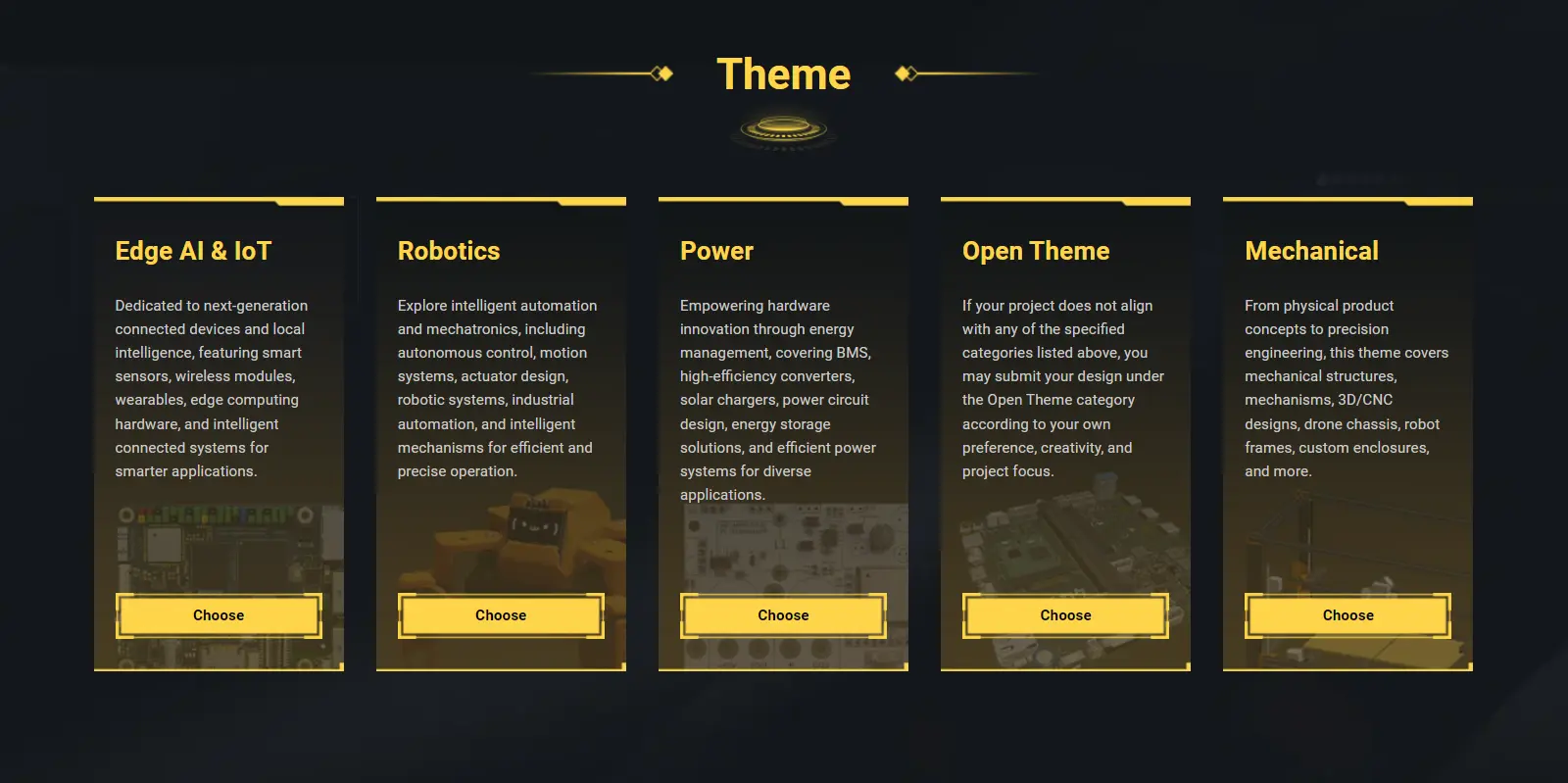
Explore the Five Project Themes
One of the strongest features of this competition is its range of categories. Participants can choose a theme that matches their project’s main purpose instead of trying to force every idea into a narrowly defined contest.
1. Edge AI & IoT
The Edge AI & IoT category focuses on intelligent connected devices, local computing, sensors, and smart embedded systems.
Projects in this category may combine microcontrollers, wireless communication, sensors, edge computing hardware, or machine learning to collect data, make decisions, and respond to real-world conditions.
Project ideas include:
- ESP32-based environmental monitoring systems
- Smart home automation and wireless control devices
- IoT energy monitoring and data acquisition systems
- Wearable sensors and connected health-monitoring prototypes
- Edge AI devices that process sensor data locally
- Wireless sensor nodes and intelligent industrial monitoring systems
A strong entry should explain how the hardware works, how data is processed, and what practical benefit the device provides.
2. Robotics
The Robotics category welcomes projects involving intelligent automation, motion control, mechatronics, actuators, and robotic systems.
Robotics projects often combine mechanical design, electronics, embedded programming, sensors, motor drivers, and control algorithms. This makes the category particularly suitable for creators who enjoy integrating multiple engineering disciplines.
Project ideas include:
- Autonomous mobile robots and obstacle-avoidance systems
- Robotic arms and actuator control systems
- Line-following and navigation robots
- Wireless robotic platforms and remote-control systems
- Automated inspection and material-handling systems
- Intelligent mechanisms for industrial or laboratory applications
When presenting a robotics project, include demonstrations of its movement, control system, mechanical construction, and ability to perform its intended task.
3. Power
The Power category focuses on energy management, power conversion, battery systems, and efficient electrical hardware.
It is particularly relevant to electronics designers working with switching converters, battery management systems, charging circuits, renewable energy, and energy storage.
Project ideas include:
- Battery management systems (BMS) and battery protection circuits
- High-efficiency buck, boost, and other DC-DC converters
- Solar charge controllers and energy monitoring systems
- Battery chargers and energy storage controllers
- Power distribution and protection boards
- Efficient power supplies and custom power electronics PCBs
For power electronics entries, explain the design specifications, circuit topology, component selection, protection mechanisms, and measured performance. Where practical, include efficiency measurements, output regulation, thermal observations, and relevant test results.
4. Open Theme
Does your project fall outside the first three technical categories, or does it combine several disciplines in a way that makes classification difficult? The Open Theme provides flexibility for projects that do not fit the other specified categories.
This category can accommodate a wide variety of original ideas, including electronic instruments, custom development boards, specialist controllers, educational hardware, and experimental engineering prototypes.
Potential project ideas include:
- Custom electronic test instruments and measurement devices
- FPGA-based digital systems
- Special-purpose controller and interface boards
- Educational electronics kits
- Novel audio, display, or signal-processing hardware
- Experimental hardware combining multiple technologies
The key is to present your project’s purpose, design decisions, functionality, and practical value clearly. Review the official contest page when selecting your category to ensure your entry is submitted appropriately.
5. Mechanical
The Mechanical category covers physical product concepts, mechanical structures, precision engineering, mechanisms, and computer-aided design and manufacturing.
This theme is useful for makers who develop physical products and engineered assemblies, including projects that combine mechanical construction with electronics or robotics.
Project ideas include:
- Custom enclosures for electronic devices
- Robot frames and mechanical assemblies
- Drone chassis and structural components
- 3D-printed mechanisms and functional prototypes
- CNC-designed parts and precision-machined components
- Mechanical fixtures, linkages, and automated mechanisms
Useful submissions should demonstrate the design process, describe material and manufacturing choices, and include CAD models, drawings, or other applicable design files.
PCBWay 9th Project Design Contest Prizes
The competition offers several prize levels, giving participants multiple opportunities to earn recognition for their projects. The awards combine cash, PCBWay coupons, and hardware that can support future development work.
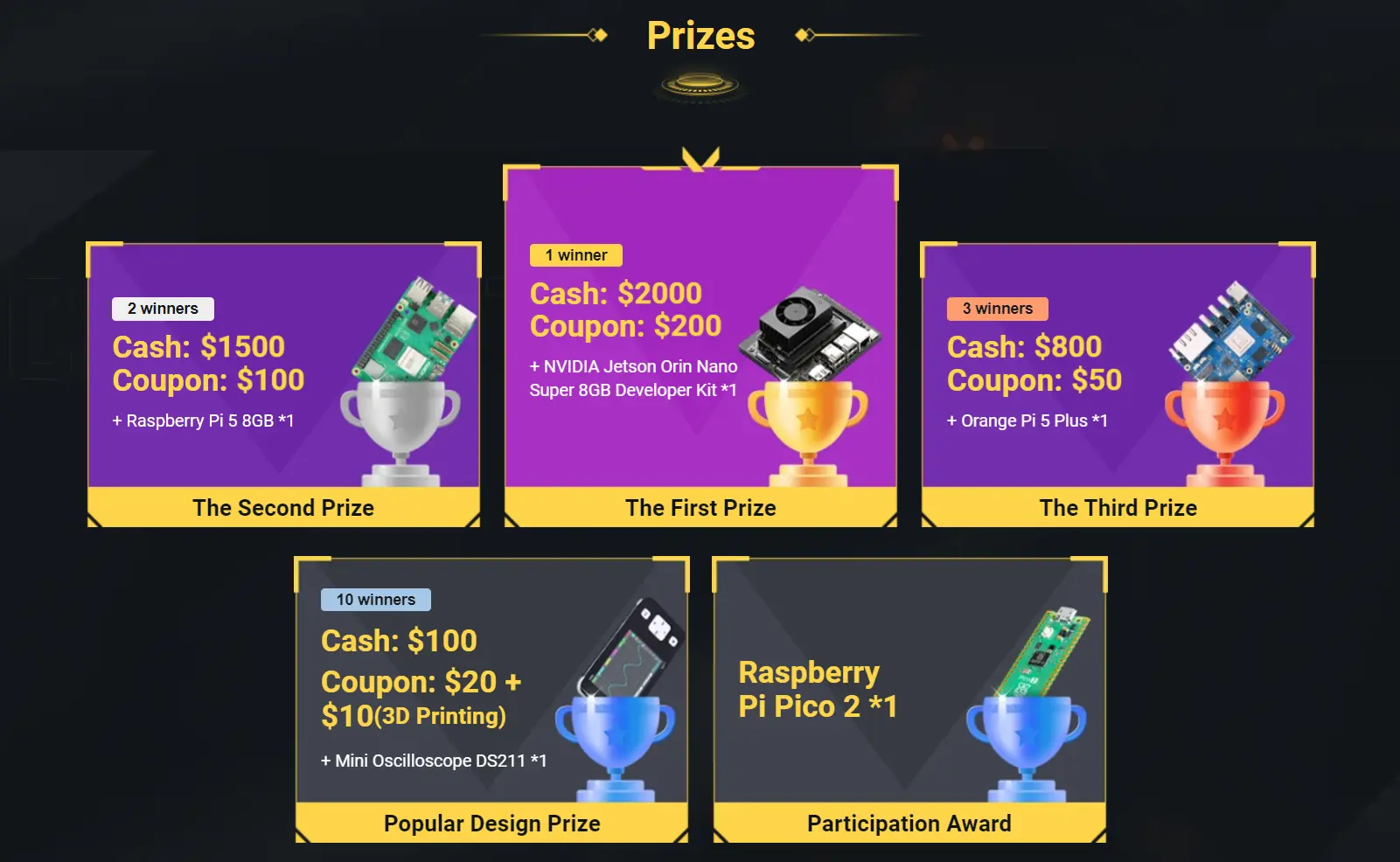
First Prize: $2,000 Plus an NVIDIA Jetson Developer Kit
Number of winners: 1
- $2,000 cash
- $200 PCBWay coupon
- One NVIDIA Jetson Orin Nano Super 8GB Developer Kit
The first-prize package is particularly appealing to developers working on edge AI, computer vision, robotics, and embedded computing. The Jetson development platform can support further experimentation with compatible AI and robotics applications.
Second Prize: $1,500 Plus Raspberry Pi 5
Number of winners: 2
- $1,500 cash for each winning entry
- $100 PCBWay coupon for each winning entry
- One Raspberry Pi 5 8GB for each winning entry
The Raspberry Pi 5 provides a versatile platform for embedded Linux, automation, connected devices, software development, and a wide range of maker projects.
Third Prize: $800 Plus Orange Pi 5 Plus
Number of winners: 3
- $800 cash for each winning entry
- $50 PCBWay coupon for each winning entry
- One Orange Pi 5 Plus for each winning entry
This prize level can be particularly interesting for makers developing compact computing systems, networked devices, and embedded applications.
Popular Design Prize: Cash, Coupons, and a Mini Oscilloscope
Number of winners: 10
- $100 cash for each winning entry
- $20 PCBWay coupon
- $10 in 3D printing rewards
- One DS211 mini oscilloscope
This award offers an additional incentive to create a project that attracts attention from the maker community. Since community popularity accounts for part of the judging score, presenting your project clearly and encouraging genuine engagement can be worthwhile.
Participation Award: Raspberry Pi Pico 2
The contest page also lists a Raspberry Pi Pico 2 as the participation award. However, participation rewards are subject to PCBWay’s stated quality, completeness, and approval requirements.
According to the official rules, projects meeting the required standards may qualify for the full 600-Bean participation reward after PCBWay approval. The Beans can be redeemed for a Raspberry Pi Pico 2 in the PCBWay Store. Participants should check the official rules for the applicable conditions.
Important: Refer to the official contest page for the definitive prize terms and any updates to the event arrangements.
How Will Projects Be Judged?
Winning a design competition takes more than building a functional prototype. Your entry must communicate why the project matters, what makes its design distinctive, and how successfully it addresses its intended purpose.
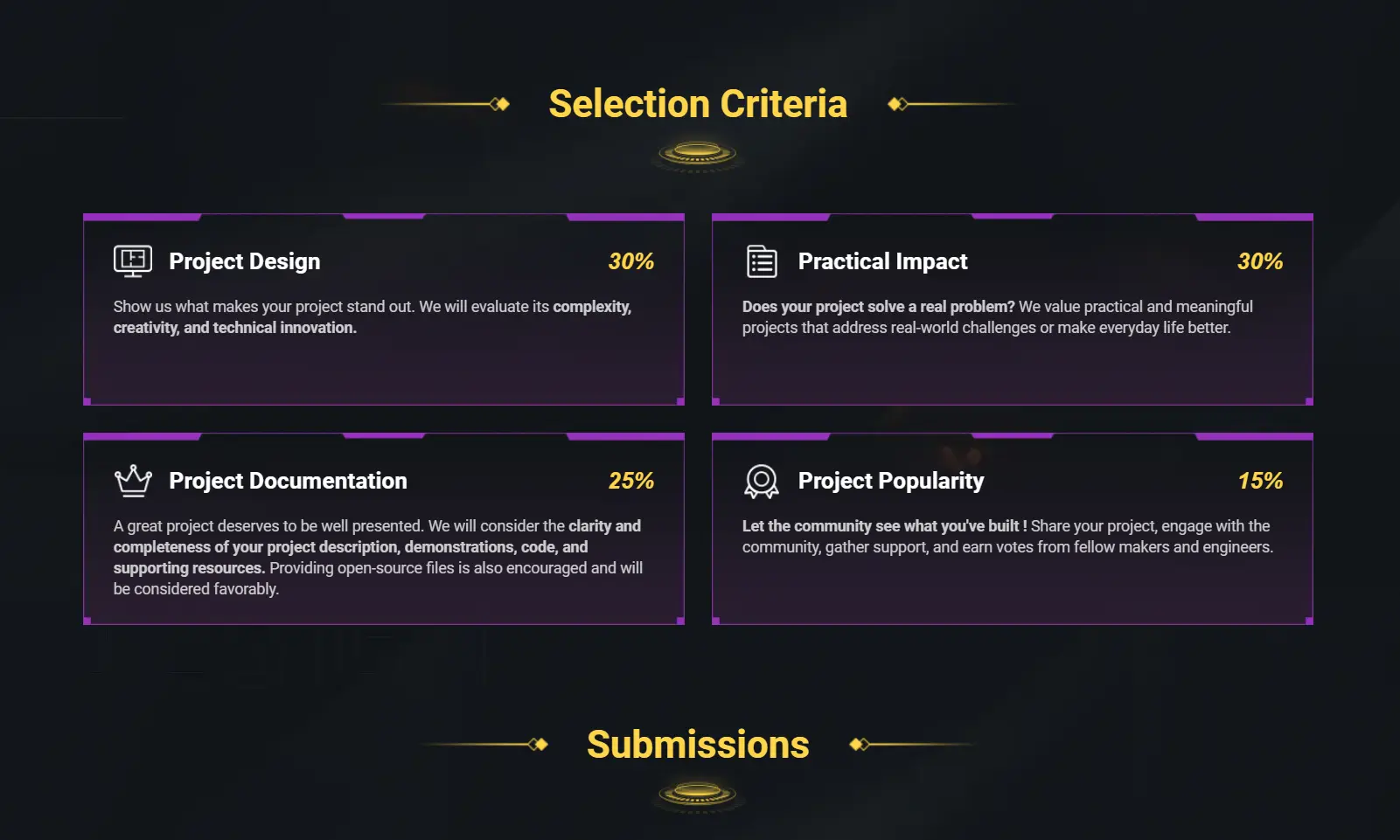
PCBWay lists four selection criteria for the 9th Project Design Contest.
| Selection Criterion | Weight | What It Means for Your Project |
|---|---|---|
| Project Design | 30% | Demonstrate technical innovation, creativity, design complexity, and sound engineering decisions. |
| Practical Impact | 30% | Explain the real-world problem your project solves and why the solution is useful. |
| Project Documentation | 25% | Provide a clear description, working demonstrations, source code, and relevant design files. |
| Project Popularity | 15% | Share the project, engage with the community, and encourage genuine interest and support. |
These percentages reveal an important point: technical design and practical impact together account for 60% of the selection score. Documentation contributes another 25%, while popularity accounts for the remaining 15%.
Developing a technically impressive device is only part of the challenge. You must also show why it is useful and provide enough evidence for judges and other makers to understand what you have accomplished.
Seven Ways to Make Your Project Submission Stronger
1. Start With a Clear Problem
Explain the specific problem your project addresses. Is it intended to make a process more efficient, reduce power consumption, simplify a task, improve measurement accuracy, or make a useful technology more accessible?
A focused problem statement makes it easier for readers and judges to understand the project’s purpose.
2. Explain What Makes Your Design Different
Describe the decisions that distinguish your project from existing solutions. These might include a novel circuit topology, a compact PCB layout, an efficient control algorithm, a practical mechanical mechanism, or the integration of multiple technologies.
A project does not need to be unnecessarily complicated to demonstrate innovation. Well-executed engineering and a thoughtful solution can be just as persuasive.
3. Demonstrate the Working Prototype
Whenever possible, provide photographs, a demonstration video, test results, or other evidence of the project in operation. For robotics, show the mechanism performing its task. For electronic instruments, include real measurements. For IoT systems, demonstrate sensing, communication, and data processing.
Clear demonstrations help distinguish a completed or tested project from an idea that exists only on paper.
4. Provide Complete Engineering Documentation
PCBWay specifically encourages participants to supply project files that help judges understand and evaluate their work.
Depending on the project, useful documentation may include:
- Schematics and PCB design files
- Gerber files and a bill of materials (BOM)
- Embedded source code and configuration files
- CAD models, mechanical drawings, and CNC files
- System block diagrams and wiring diagrams
- Photographs, demonstration videos, and test results
Not every project needs every file type. Provide the resources applicable to your design, and ensure that the documentation is organized, readable, and consistent with the demonstrated hardware.
5. Include Measurements and Test Results
Whenever relevant, support your design claims with measurable results. Power electronics projects can include efficiency and regulation measurements; sensor projects can show accuracy and response; robotic systems can demonstrate repeatability or task performance.
Use actual results rather than unsupported claims. Even a small set of well-explained tests can make a technical submission substantially more informative.
6. Share Your Project With the Community
Because project popularity accounts for 15% of the judging criteria, community engagement is worth considering. Write an informative project description, use clear images, explain your design choices, and share the entry with people who may find it useful.
Focus on meaningful engagement and genuine interest in your work rather than simply trying to collect votes.
7. Consider Open-Source Documentation
PCBWay states that the availability of open-source files is encouraged and will be considered favorably under project documentation.
If your project can be shared openly, consider publishing the appropriate source code, design files, instructions, and a clear explanation of how the system works. Make sure you have the right to distribute everything you share, including third-party libraries, models, and other resources.
Meet the Judges
The contest features a panel of professionals and creators with experience across electronics, hardware engineering, robotics, embedded systems, AI, and software development.

The judges listed on the official contest page are:
- Atara Byte: Electronic engineer and creator in electrical engineering.
- Kutluhan Aktar: Independent researcher, product developer, AI and software developer, and maker.
- Marcin Plaza: Content creator and hardware engineer at Midjourney.
- Aaed Musa: Mechanical engineer and YouTuber with an interest in robotics.
- Ben Jordan: Principal systems architect specializing in high-speed digital and AI-automated hardware, with more than 25 years of industry leadership noted on the contest page.
- Shawn Hymel: Instructor and course creator focused on embedded systems, IoT, and machine learning.
- Anson Bao: Electronic engineer and head of PCB design at PCBWay.
The breadth of expertise represented by the panel reflects the contest’s emphasis on both engineering implementation and practical innovation.
How to Participate in the PCBWay Contest
PCBWay provides two submission routes. Choose the approach that best suits how you manage your projects on the platform.
Method 1: Submit Through the Contest Page
- Visit the official contest page.
- Review the five project themes, contest rules, and required submission details.
- Click the Participate Now button.
- Follow the platform’s submission process and select the appropriate contest theme.
- Provide a clear project description and the supporting files relevant to your design.
- Review your submission to ensure that it is complete and follows the contest requirements.
Method 2: Submit Through PCBWay Community
- Open the PCBWay Community and create a project or update an existing project as appropriate.
- Prepare the project page with a description, images, demonstrations, and relevant technical resources.
- Use the Submit Project to… option.
- Select the appropriate theme for the 9th Project Design Contest.
- Follow the submission instructions and verify that the project has been entered into the intended contest category.
Check the official website before submitting to confirm the current interface, submission requirements, and status of the contest.
Important Contest Rules You Should Know
Before entering, review the rules carefully. The main requirements published on the contest page include the following.
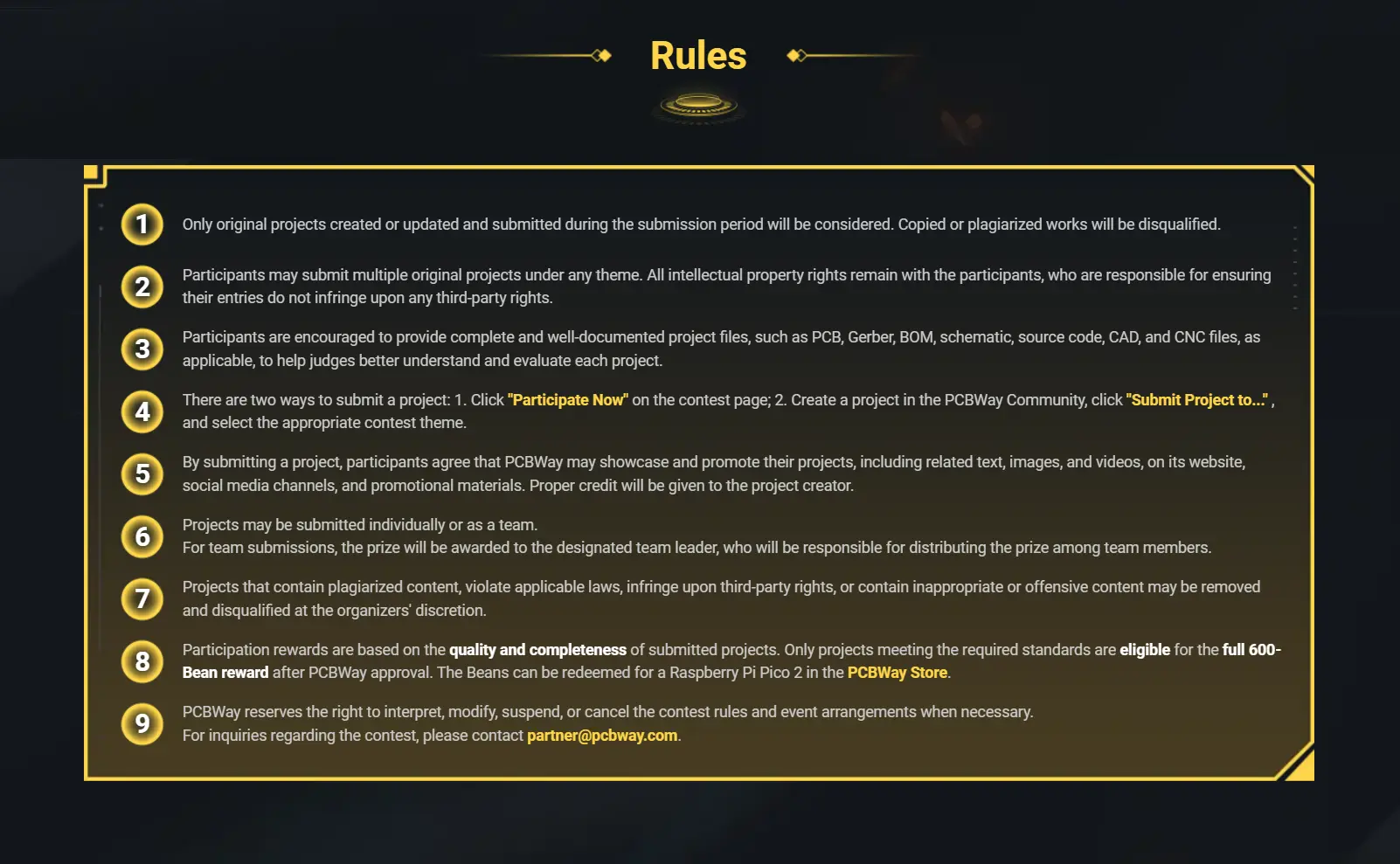
- Original work is required: Only original projects created or updated and submitted during the official submission period will be considered. Copied or plagiarized work is subject to disqualification.
- Multiple entries are permitted: Participants may submit multiple original projects under any of the available themes.
- Individual and team entries are allowed: Projects may be submitted individually or as a team. For a team entry, the designated team leader receives the prize and is responsible for distributing it among team members.
- Intellectual property remains with the participant: Participants retain their intellectual property rights and are responsible for ensuring that their projects do not infringe third-party rights.
- Documentation is encouraged: Include relevant PCB, Gerber, BOM, schematic, source code, CAD, CNC, or other applicable files.
- Promotion and attribution: By submitting a project, participants agree that PCBWay may showcase and promote the project, including related text, images, and videos, on its website, social media, and promotional materials. Proper credit will be given to the creator.
- Content must comply with the rules: Projects involving plagiarism, applicable legal violations, infringement of third-party rights, or inappropriate or offensive content may be removed or disqualified.
- Participation rewards are conditional: The quality and completeness of the submitted project matter. The full 600-Bean participation reward is subject to PCBWay approval and the stated requirements.
PCBWay also reserves the right to interpret or modify the rules and to suspend or cancel the contest when necessary. For questions about the competition, the official page lists partner@pcbway.com as the contact email.
What Types of Projects Are Already Appearing in the Contest Gallery?
The submissions gallery illustrates the variety of work that can be presented through the competition. The examples shown include an 8×32 LED matrix panel, a robotics project, an FPGA-based mixed-signal oscilloscope, an IoT node, a compact LED keychain, a MOSFET-related PCB, and a radio-control project. The gallery also includes a mechanized yogurt-filling machine.
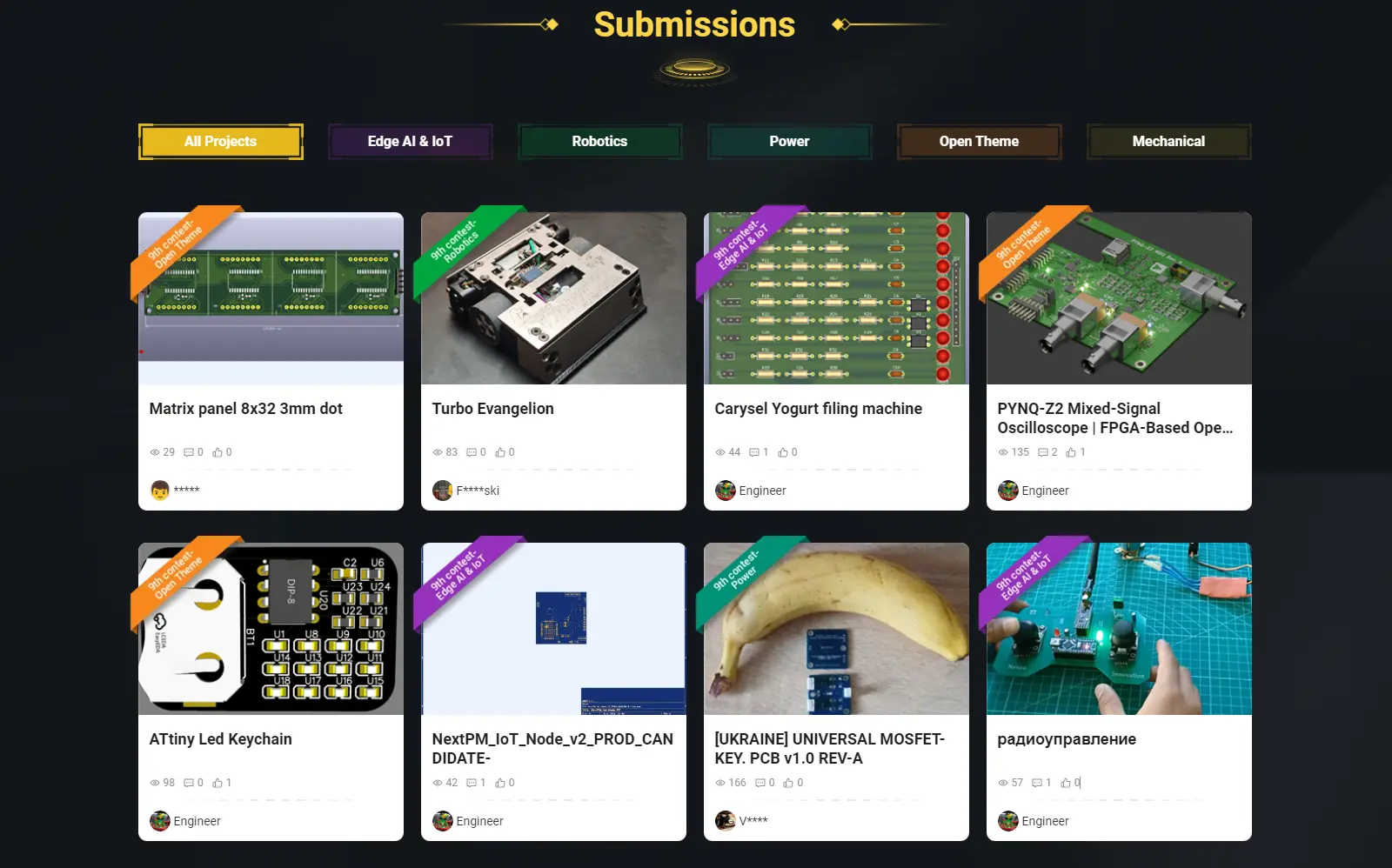
These examples demonstrate that engineering creativity can take many forms. A project may focus on a custom PCB, a complete working device, a mechanical mechanism, an embedded platform, or a combination of hardware and software.
Rather than copying an existing entry, use the gallery to understand how other creators present their ideas. Identify the problem your own project solves, document your design decisions, and show what makes your implementation distinct.
Contest Timeline: When Should You Submit?
The official schedule provides a clear window for completing and submitting projects.
- September 1, 2026 – January 24, 2027: Submission period.
- January 25 – February 25, 2027: Review period.
- March 5, 2027: Results announcement.
If you are still developing your project, use the remaining submission period to finish the hardware, validate its operation, prepare the documentation, and improve the quality of your project page.
A complete and understandable submission is generally more useful to the judges than a rushed entry with missing files or unclear explanations. However, leave enough time to follow the actual submission procedure and resolve any issues before the deadline.
Turn Your Engineering Idea Into a Project Worth Sharing
The PCBWay 9th Project Design Contest 2026 is an opportunity for engineers, electronics designers, students, and makers to share original work and compete for valuable rewards. With categories covering intelligent connected devices, robotics, power electronics, mechanical engineering, and open-theme projects, the competition welcomes a broad range of technical ideas.
The strongest approach is to focus on more than the prize. Build something useful, demonstrate that it works, explain the engineering behind it, and provide the documentation needed for others to understand your design.
Remember that project design and practical impact account for 60% of the selection score, while documentation contributes another 25%. Give your project a clear purpose, back up your claims with evidence, and make the submission easy to evaluate.
Have an original electronics, robotics, power, or mechanical project ready to share? Explore the contest themes, prepare your documentation, and submit your entry before January 24, 2027.
Visit the official PCBWay 9th Project Design Contest page and participate.
Frequently Asked Questions
What is the PCBWay 9th Project Design Contest?
It is an engineering and hardware project competition organized by PCBWay. Participants can submit original projects across five themes: Edge AI & IoT, Robotics, Power, Open Theme, and Mechanical.
What is the last date to submit a project?
The submission deadline is January 24, 2027. Check the official contest page for the latest details.
What is the first prize in the competition?
The first prize includes $2,000 cash, a $200 PCBWay coupon, and an NVIDIA Jetson Orin Nano Super 8GB Developer Kit. There is one first-prize winner.
Can students and beginners participate?
Yes. The contest welcomes innovators, engineers, makers, and students. All submissions must meet the originality, documentation, and other requirements specified in the official rules.
Can I submit more than one project?
Yes. Participants can submit multiple original projects under any of the available themes, provided each submission meets the contest requirements.
Can a team participate?
Yes. Both individual and team submissions are allowed. For team entries, the designated team leader receives the prize and is responsible for distributing it among team members.
Do I need to submit PCB or source files?
Participants should provide relevant project documentation, such as schematics, PCB design files, Gerber files, a bill of materials (BOM), source code, CAD models, CNC files, and supporting resources, as applicable.
Is there a participation reward?
The contest lists a Raspberry Pi Pico 2 as the participation reward. The full 600-Bean reward is subject to project quality, completeness, and PCBWay approval. Review the official rules for the exact conditions.
When will the results be announced?
The results are scheduled to be announced on March 5, 2027, following the review period from January 25 to February 25, 2027.
Raspberry Pi 5 Pinout, Specifications, and Pricing: A Complete Guide
IOT Based Air Quality Monitoring System with ESP32 & BME680 Sensor
TDS Sensor Based Water Quality Monitoring System Using ESP32 and Arduino
Arduino UNO R4 Minima and Wi-Fi: Pinout, Specifications & Pricing
