
When you make a song with artificial intelligence, two questions usually follow. The first is legal: do you actually own this music? The second is practical: why did the tool reject your lyrics or audio upload, even when you used a poem written more than a century ago?
Most guides treat these questions as part of the same legal problem. In reality, they involve two separate systems that operate independently. Copyright law determines what belongs to you and which creative rights you can claim. Automated platform filters decide what a tool will process at a particular moment. Passing a filter does not establish legal permission, and being blocked by one does not mean you have violated copyright law. Understanding this distinction helps you know what to do in each situation.
Related Articles:
- What Is a Proxy Server and How Does It Work?
- 5 Raspberry Pi AI Projects You Can Build with One API Key
- ESP32 Air Quality Monitoring with BME680
- Water Quality Monitoring with TDS Sensor, ESP32 and Arduino
- Build a Powerful and Affordable Raspberry Pi Media Server
- Could 2026 Be the Year of Linux Gaming?
- Linux Enterprise Server vs Windows Server
- Raspberry Pi 5 Pinout, Specifications and Pricing
- Create Technical Engineering Animations Using Seedance 3.0
What the Law Protects in an AI-Assisted Song
Under US law, copyright protection requires a human author. In Part 2 of its report on AI-generated outputs, published January 29, 2025, the US Copyright Office concluded that material generated entirely by artificial intelligence is not protected by copyright. Prompts alone do not make someone an author because the law generally treats them as instructions or ideas rather than original creative expression.
However, the parts you create yourself can receive copyright protection. These may include lyrics you write, a melody you compose by humming or playing an instrument, or original creative changes you make to an arrangement. Copyright protects your human contributions even when software generates the accompanying music or backing audio.
Federal courts have reinforced this principle. In Thaler v. Perlmutter, the D.C. Circuit confirmed the human-authorship requirement in March 2025. On March 2, 2026, the US Supreme Court declined to review the case, leaving that legal position in place.
If you apply for US copyright registration, which creates a formal government record of your copyright claim, you must identify your human contributions and exclude AI-generated material that goes beyond minimal or otherwise unclaimable contributions.
Copyright rules differ between countries. The UK, for example, recognizes a category of computer-generated works, under which authorship is generally assigned to the person who made the necessary arrangements for the work to be created. Check the applicable laws in your country if you plan to release or commercially use AI-generated music. This article is not legal advice.
It is also important to understand that a lack of copyright protection does not automatically make a track free for anyone to use. Contractual restrictions, platform terms, and laws protecting an artist’s voice, name, and identity may still apply.
“Commercial Rights” Are Not the Same as Owning the Copyright
Many paid AI music plans advertise “commercial rights.” This wording can lead creators to assume that they own the finished song in the same way they would own a track they composed and recorded themselves. However, commercial usage rights and copyright ownership are two different things.
Commercial rights come from a contract with the platform. When you use a service, you agree to its terms of service, which specify what you can and cannot do with the generated output. Depending on your subscription, the platform may allow you to sell the track, monetize it, or include it in commercial videos and other projects.
Copyright, on the other hand, is a legal right that can allow you to prevent others from copying or using your protected creative work without permission. A private agreement with an AI platform cannot create copyright protection where the law does not recognize it.
This distinction is particularly important for fully AI-generated tracks. A platform may allow you to use a song commercially, but you may have limited legal grounds to stop someone else from reusing the same audio. Your agreement with the platform does not automatically bind other people who never signed that contract.
Before releasing a song, always check what your subscription allows. Free and paid plans often have different usage conditions, and paid subscriptions may provide broader commercial permissions. It is also worth keeping a copy of the platform’s terms from the date you generate your music, since companies can update their policies over time.
Why the Tool Refused a Poem That Is Over 100 Years Old
Older literary works eventually enter the public domain. This means their copyright protection has expired, allowing people to use them without obtaining permission from the original copyright holder. In the United States, works published before 1931 are in the public domain as of 2026.
Despite this, automated lyric filters can still reject historical texts. To understand how this works in practice, we tested Suno’s custom-lyrics mode with three well-known poems: Emily Dickinson’s “Hope is the thing with feathers,” William Blake’s “The Tyger,” and Sara Teasdale’s “There Will Come Soft Rains.” All three works are long out of copyright in the United States.
Suno rejected all three poems for violating its content policy. The results remained the same whether we included or removed their titles, stripped out punctuation, or formatted the text to resemble song lyrics. However, an original poem written specifically for the test passed without any issues and successfully produced two finished songs.
Suno does not publicly explain exactly how its filter makes these decisions, but the pattern is worth noting. The historic poems were rejected regardless of the formatting changes, while newly written lyrics were accepted. Whatever the filtering mechanism checks, it does not appear to reliably distinguish between text that is still copyright-protected and material whose copyright has expired. Famous literary text can therefore be treated as potentially protected content.
We have also encountered situations where lyrics that merely resemble well-known songs get flagged. Some of these appear to be false positives. In certain cases, making small changes to the wording has been enough to get the text accepted, suggesting that the system may respond to recognizable wording rather than accurately determining its legal status.
Technology press reporting in April 2026 also confirmed that Suno’s filters could be bypassed through relatively small changes. However, getting past a filter does not grant copyright permission or establish that the material is legally cleared. A successful submission is not the same as legal approval.
The practical lesson is straightforward: the most reliable input for an AI song maker is text nobody has published before which is your own words. Original lyrics are far less likely to trigger automated matching systems, and they also provide the human creative contribution that copyright law can protect.
Why Uploads of Real Songs Bounce and Models Disagree
Uploading existing audio into an AI music platform introduces another layer of automated filtering. On some services, uploading a commercially released recording for remixing, covering, or modification can result in an immediate rejection.
We tested this by uploading 30-second preview clips of three released songs: an Adele track, an Ed Sheeran track, and a less widely known independent recording. Suno’s upload and cover features rejected every file with a content-safety error. The relative obscurity of the independent track made no difference. In contrast, AI-generated songs that we had created ourselves uploaded without any problems.
Suno does not disclose the exact technology behind these checks, but the results are consistent with a possible audio-fingerprinting approach. Audio fingerprinting identifies recordings by comparing their distinctive acoustic characteristics against a database of known tracks. Even a relatively obscure commercial release may be recognizable if its recording is included in such a database.
However, automated filters are not consistent across platforms. During the same week, we tested the same Adele clip with several other audio models and tools, including stem separation, audio-to-audio processing, and remix services. Across 12 calls, none rejected the clip.
This comparison highlights an important point: a platform’s filter response tells you nothing conclusive about your legal rights. Suno rejected the recording, while the other tools processed it without difficulty. But a successful upload does not give you permission to use the original recording. If you do not own or license the recording, publishing the resulting material may still infringe the rights of its owner.
One reason major platforms take a strict approach is the legal pressure facing the AI music industry. Record labels sued AI music companies Suno and Udio in 2024 over alleged copyright infringement. Universal Music settled with Udio in late October 2025, while Warner Music reached settlements with Udio and, on November 25, 2025, with Suno. These agreements included plans for licensed music models in 2026.
Against this background, automated filters are one way AI music companies can manage potential copyright risks and limit the use of protected recordings without authorization.
What Spotify Actually Allows for AI Music
Creators often worry that streaming services will prohibit music made with artificial intelligence. Spotify does not ban AI-assisted music outright, but it has introduced policies to address catalog spam, deceptive releases, and unauthorized vocal impersonation.
On September 25, 2025, Spotify announced three important measures:
- Impersonation: AI voice clones and other forms of vocal impersonation are permitted only when the artist whose voice is being imitated has given permission.
- Spam: Spotify introduced measures to identify tracks and uploaders using spam tactics, flag the content, and prevent it from being recommended. The company also reported removing more than 75 million spammy tracks over the previous 12 months.
- Disclosure: Spotify announced support for a DDEX industry standard that allows labels and distributors to disclose how AI was used in a song through its credits.
For independent musicians, the practical requirements are relatively straightforward. Release music under your own artist name, avoid imitating a real artist’s voice without permission, do not flood distributors with repetitive or low-quality releases, and disclose your use of AI when your distributor requests that information.
The important distinction is that using AI to assist with music production is not the same as impersonating another artist or manipulating streaming platforms.
A Practical Checklist Before You Make and Share an AI Song
Creating and releasing AI-assisted music responsibly does not have to be complicated. A few basic precautions can help you avoid unnecessary platform rejections and reduce potential legal problems.
Before releasing your next project, review the following checklist:
- Write your own lyrics: Use original lyrics or substantially rework AI-generated drafts. Keep dated drafts and other records of your creative process to help establish your human contribution.
- Avoid unowned recordings: Do not assume that a platform accepting an uploaded recording gives you permission to use it. Obtain the necessary rights or licenses before publishing.
- Check subscription terms: Review the commercial usage permissions included in your free or paid plan before monetizing a track.
- Respect vocal identities: Do not publish AI-generated vocals that clone or imitate a real artist without the necessary permission.
- Rewrite flagged lyrics properly: If a tool rejects your text, consider writing the passage in your own words rather than disguising or slightly modifying borrowed lyrics to get around the filter.
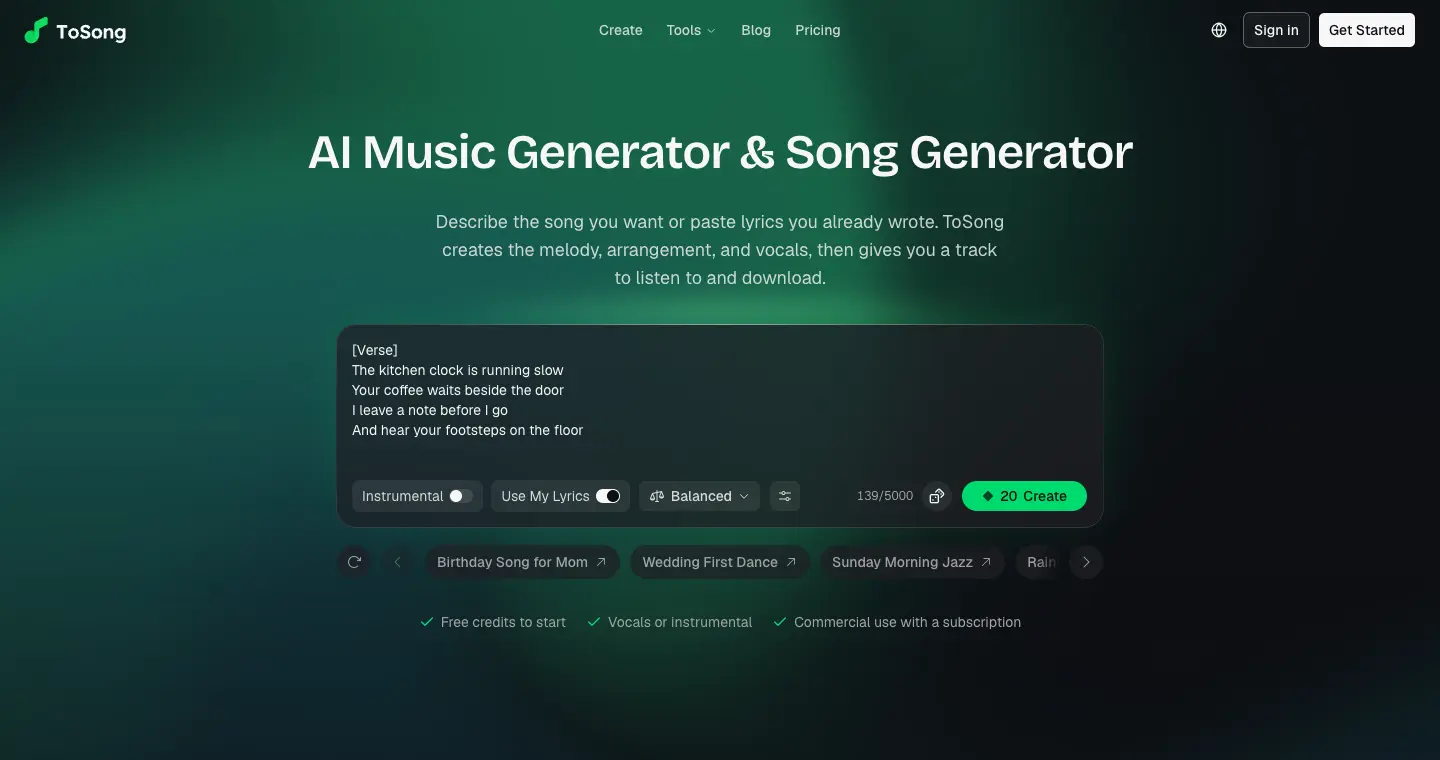
Your own words are also the easiest place to start. When you begin a song from original lyrics in an AI music generator, you are far less likely to hit a filter, and the lyrics themselves remain your work.
Conclusion: Two Systems Answering Two Different Questions
Creating music with AI involves two separate systems, and understanding the difference between them is essential.
Copyright law determines which parts of a song you can legally claim as your own, generally protecting human creative contributions rather than material generated entirely by AI. Automated platform filters, meanwhile, decide whether a particular tool will accept your lyrics or audio, often based on content-matching and safety checks.
Neither system determines the outcome of the other. A song passing an automated filter does not mean you have permission to use every element in it, just as a rejected poem is not necessarily copyrighted or illegal to use.
For creators, the most practical approach is to use original lyrics, understand the permissions attached to their AI music subscription, and obtain the necessary rights before uploading or publishing existing recordings. Your own creative contributions remain the strongest foundation for making and sharing AI-assisted music.
Seedance 2.5: Preview Your Custom Enclosure in Motion Before Building
How to Create Technical Engineering Animations Using Seedance 3.0
IOT Based Air Quality Monitoring System with ESP32 & BME680 Sensor
TDS Sensor Based Water Quality Monitoring System Using ESP32 and Arduino
