
The Barkhausen Criterion is a fundamental condition used to determine whether an electronic feedback circuit can produce and maintain continuous oscillations without an external input signal. It is particularly important in the analysis and design of electronic oscillators, including RC, LC, and crystal oscillator circuits.
An oscillator converts DC power from a power supply into a periodic AC signal at a particular frequency. Unlike an amplifier, an oscillator does not normally require an external AC input signal. Instead, it uses positive feedback to generate and sustain the output waveform.
For an oscillator to produce sustained oscillations, the feedback signal must return to the input with the correct phase and sufficient magnitude. These requirements are expressed by the two fundamental conditions of the Barkhausen Criterion for Oscillators:
- The magnitude of the loop gain must be unity: |Aβ| = 1.
- The total phase shift around the feedback loop must be 0°, 360°, or an integral multiple of 360°.
Here, A represents the voltage gain of the amplifier and β represents the feedback factor of the feedback network. Their product, Aβ, is known as the loop gain or loop transmission.
When these two conditions are satisfied at a particular frequency, the feedback signal reinforces the signal already present in the circuit rather than cancelling it. This allows the oscillator to maintain a periodic output with approximately constant amplitude. Therefore, understanding the Conditions for Sustained Oscillation is essential for analyzing oscillator circuits.
Why Is the Barkhausen Criterion Needed?
In a conventional amplifier, an input signal is applied to produce an amplified output. An oscillator works differently because there is ideally no external AC input signal. In other words, the source input can be considered zero:
Vs = 0
Therefore, the feedback signal itself must provide the voltage necessary to drive the amplifier. For this to happen continuously, the feedback voltage must have the correct phase relationship with the amplifier input and must have sufficient magnitude to compensate for the energy lost in the circuit.
The Barkhausen Criterion provides the mathematical conditions required for this regenerative feedback process. If the conditions are not satisfied, the oscillations either die out or increase uncontrollably instead of becoming sustained.
Related Articles:
- Difference Between Amplifier and Oscillator
- Difference Between Positive Feedback and Negative Feedback
- Different Types of Oscillators with Working and Applications
- Voltage Controlled Oscillator VCO Circuit Using 555 Timer IC
- RC Phase Shift Oscillator Circuit Working & Applications
- TDA2030 Audio Amplifier Circuit: Mono, Stereo and Bass Amplifier
- Wien Bridge Oscillator Circuit: Working and Applications
- Bipolar Junction Transistor (BJT) Biasing and Stabilization
Basic Concept of Oscillation with Positive Feedback
Consider a feedback amplifier having an amplifier gain A and a feedback factor β. A portion of the output voltage is fed back to the input through the feedback network.
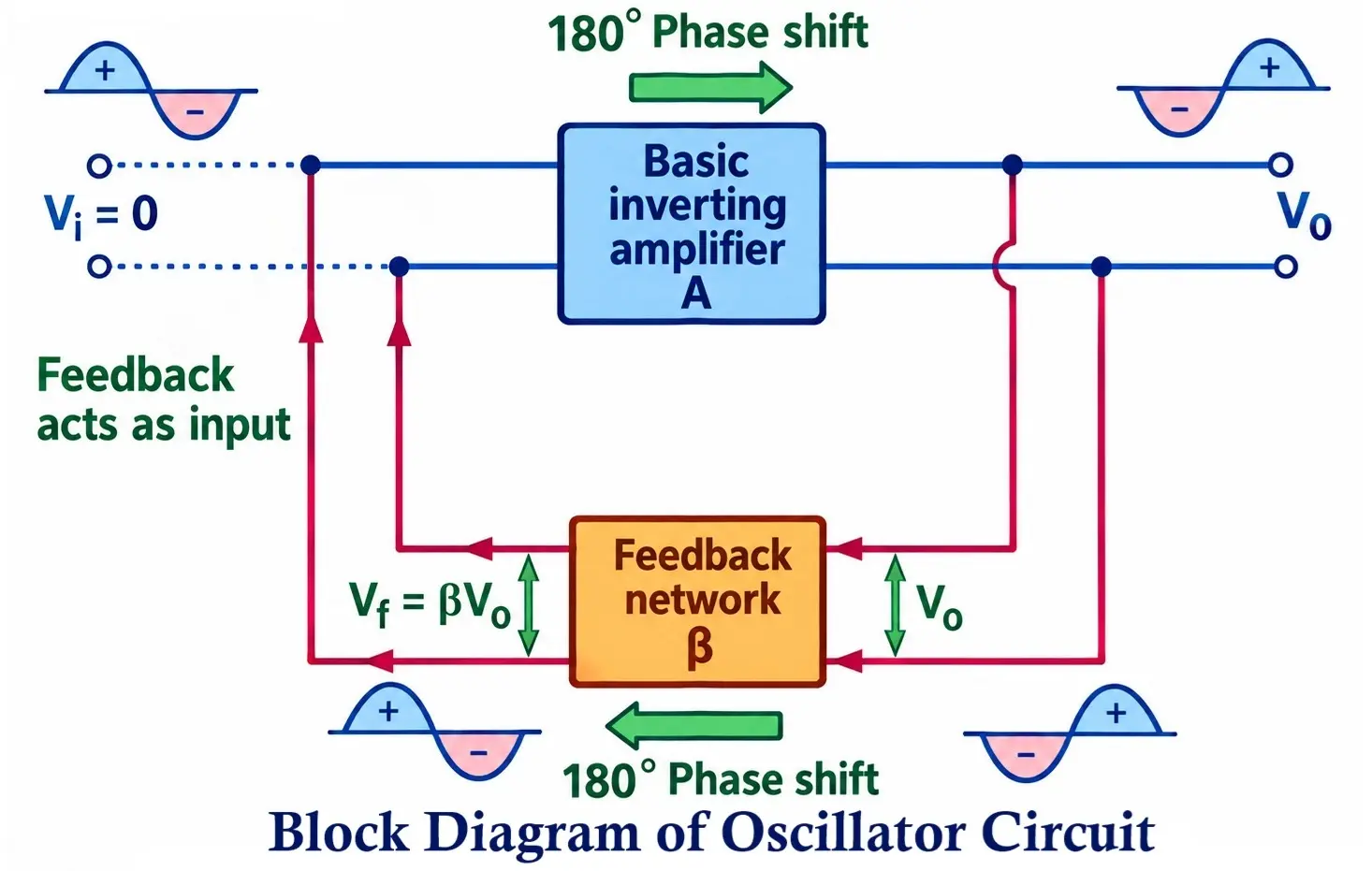
For an oscillator, the feedback must be positive at the desired oscillation frequency. This means that the feedback voltage must return to the amplifier input with the appropriate phase so that it reinforces the existing signal.
The output voltage can be expressed as:
Vo = A Vi
If the feedback network returns a fraction β of the output to the input, the feedback voltage is:
Vf = β Vo
Combining these relationships gives:
Vf = AβVi
For an oscillator, there is no external input, so the feedback signal must effectively reproduce the input signal required by the amplifier. This leads to the fundamental oscillation condition:
Aβ = 1
For circuits where the amplifier or feedback network introduces an inversion, the condition may be written as:
−Aβ = 1
Both forms express the same fundamental requirement when the associated phase shift is taken into account.
Thus, the Barkhausen Criterion for Oscillations consists of two simultaneous requirements: the correct loop-gain magnitude and the correct total phase shift around the feedback loop.
Barkhausen Criterion for Oscillators: The Two Fundamental Conditions
The Barkhausen Criterion for Oscillators consists of two fundamental conditions that must be satisfied simultaneously at the desired frequency of oscillation. These conditions determine whether the feedback signal will continuously reinforce the signal in the oscillator and produce sustained oscillations.
The two conditions are:
- Magnitude condition: The magnitude of the loop gain must be unity, or |Aβ| = 1.
- Phase condition: The total phase shift around the feedback loop must be 0°, 360°, or an integral multiple of 360°.
These conditions can also be expressed using the complex loop gain:
Aβ = 1 ∠ 0°
Therefore, both the amplitude and phase requirements must be satisfied at the same frequency for continuous oscillation to occur.
1. Magnitude Condition: |Aβ| = 1
The first Barkhausen Criterion requires the magnitude of the loop gain to be equal to unity:
|Aβ| = 1
Here, A is the gain of the amplifier and β is the feedback factor of the feedback network. Their product Aβ represents the overall gain obtained when a signal travels once around the complete feedback loop.
The magnitude condition means that after a signal passes through the amplifier and feedback network and returns to the input, its amplitude must be exactly sufficient to replace the energy lost during one cycle. The returned signal therefore maintains the amplitude of the existing oscillation.
For example, if the amplifier has a gain of 100 and the feedback network returns 1% of the output to the input:
A = 100
β = 0.01
|Aβ| = 100 × 0.01 = 1
Therefore, the magnitude condition is satisfied.
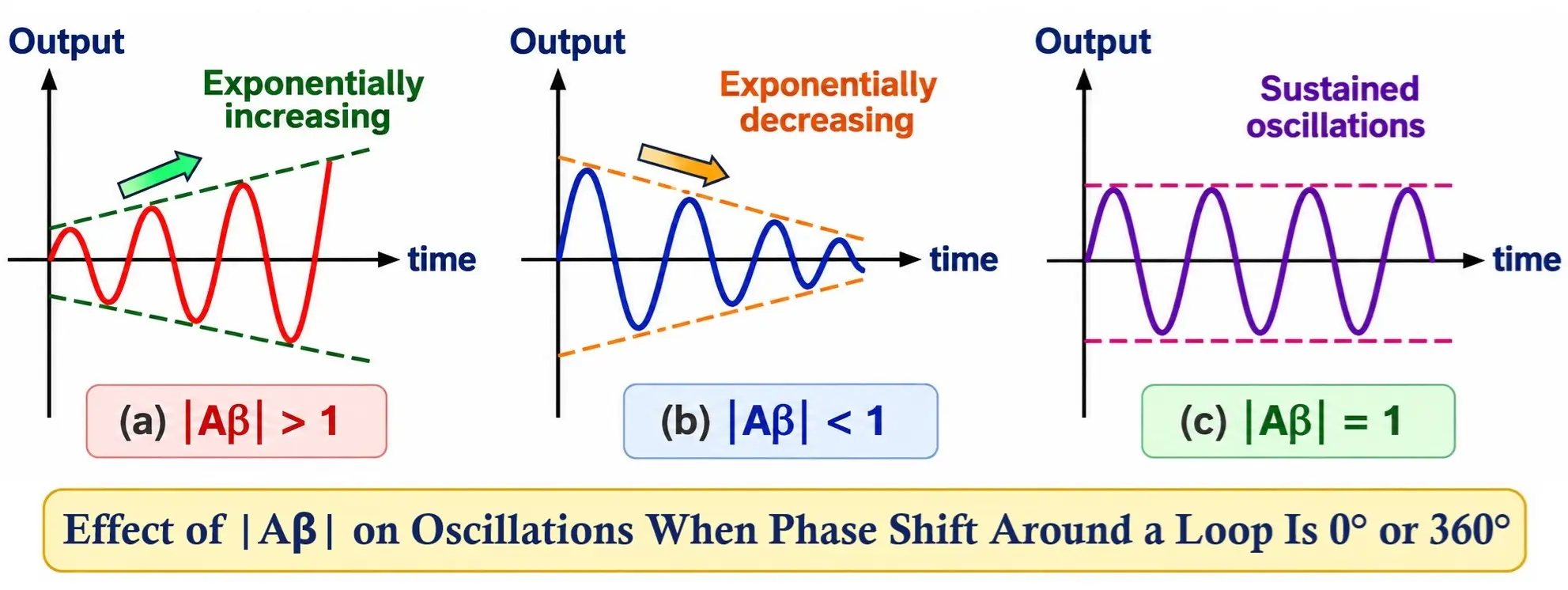
What Happens When |Aβ| > 1?
If the loop-gain magnitude is greater than unity:
|Aβ| > 1
the feedback signal returning to the input has greater amplitude than the signal required to compensate for the losses in the circuit. As a result, the amplitude of the oscillations tends to increase from cycle to cycle.
This condition is commonly used during the startup of an oscillator. A small initial disturbance or noise signal can be amplified when the loop gain is slightly greater than unity, allowing oscillations to build up.
However, if |Aβ| > 1 remains unchanged, the amplitude cannot increase indefinitely in a practical circuit. Amplifier nonlinearity, device limitations, supply-voltage limits, or another amplitude-control mechanism eventually reduces the effective loop gain. The circuit then approaches a condition where the effective loop gain becomes approximately unity.
What Happens When |Aβ| < 1?
If the loop-gain magnitude is less than unity:
|Aβ| < 1
the feedback signal is too small to compensate for the energy lost in the oscillator during each cycle. Consequently, the amplitude of the oscillation decreases with time and the oscillations eventually die out.
This is known as damped oscillation. Therefore, a circuit with a loop gain below unity cannot maintain continuous oscillations.
What Happens When |Aβ| = 1?
When:
|Aβ| = 1
the feedback signal has exactly the required magnitude to compensate for the losses in the oscillator. The amplitude of the oscillation can therefore remain constant, provided the phase condition is also satisfied.
This is the ideal sustained oscillation condition.
It is important to note that the magnitude condition alone is not sufficient. Even if |Aβ| = 1, oscillations will not be sustained unless the feedback signal also returns with the correct phase.
2. Phase Condition: ∠Aβ = 0° or 360°
The second condition of the Barkhausen Criterion for Oscillations specifies the phase relationship of the signal after it travels through the complete feedback loop.
The total phase shift around the loop must be:
∠Aβ = 0°, ±360°, ±720°, …
In general, this can be written as:
∠Aβ = 2nπ radians
where n is an integer.
In practical oscillator analysis, the condition is commonly stated as a total phase shift of 0° or 360°. These values are equivalent because a 360° phase shift brings a sinusoidal signal back into phase with its original signal.
Why Is the Phase Condition Necessary?
The feedback signal must reinforce the signal already present at the amplifier input. If the returned signal is in phase with the input signal, the feedback is positive feedback and the signal is reinforced on every cycle.
For example, consider an amplifier that introduces a phase shift of 180°. If the feedback network introduces another 180° phase shift, the total phase shift becomes:
180° + 180° = 360°
The feedback signal is therefore in phase with the original signal at the input, producing positive feedback.
Alternatively, if the amplifier and feedback network together introduce a total phase shift of 0°, the signal also returns in phase with the original signal.
Phase Condition and Positive Feedback
The phase condition can be understood by considering what happens when the feedback signal returns to the input:
- 0° or 360° phase shift: Feedback is reinforcing and supports oscillation.
- 180° phase shift: Feedback opposes the signal and tends to produce cancellation rather than sustained oscillation.
Therefore, the phase condition ensures that the feedback signal adds constructively to the signal in the oscillator rather than cancelling it.
Complex Form of the Barkhausen Criterion
Since amplifier gain and feedback factor can both be frequency-dependent and may contain phase information, the loop gain is generally a complex quantity:
Aβ = |Aβ| ∠ φ
For sustained oscillation, the Barkhausen conditions require:
|Aβ| = 1
φ = 0° or 360°
Thus, the complete condition can be represented as:
Aβ = 1 ∠ 0°
or, in rectangular form:
Aβ = 1 + j0
This mathematical representation shows that the loop gain must have a magnitude of unity and zero net phase shift at the oscillation frequency.
Both Conditions Must Be Satisfied Simultaneously
The two conditions of the Barkhausen Criterion are not independent requirements that can be satisfied at different frequencies. They must be satisfied simultaneously at the same frequency.
Therefore, the frequency at which:
|Aβ| = 1
and
∠Aβ = 0° or 360°
is the frequency at which the circuit can sustain oscillations. This frequency is called the frequency of oscillation.
In an idealized analysis, satisfying both conditions produces constant-amplitude oscillations. In a practical oscillator, however, startup, device nonlinearity, losses, and amplitude stabilization determine how the circuit reaches and maintains its steady-state operating condition.
Different Types of Oscillators with Working and Applications
Voltage Controlled Oscillator VCO Circuit Using 555 Timer IC
