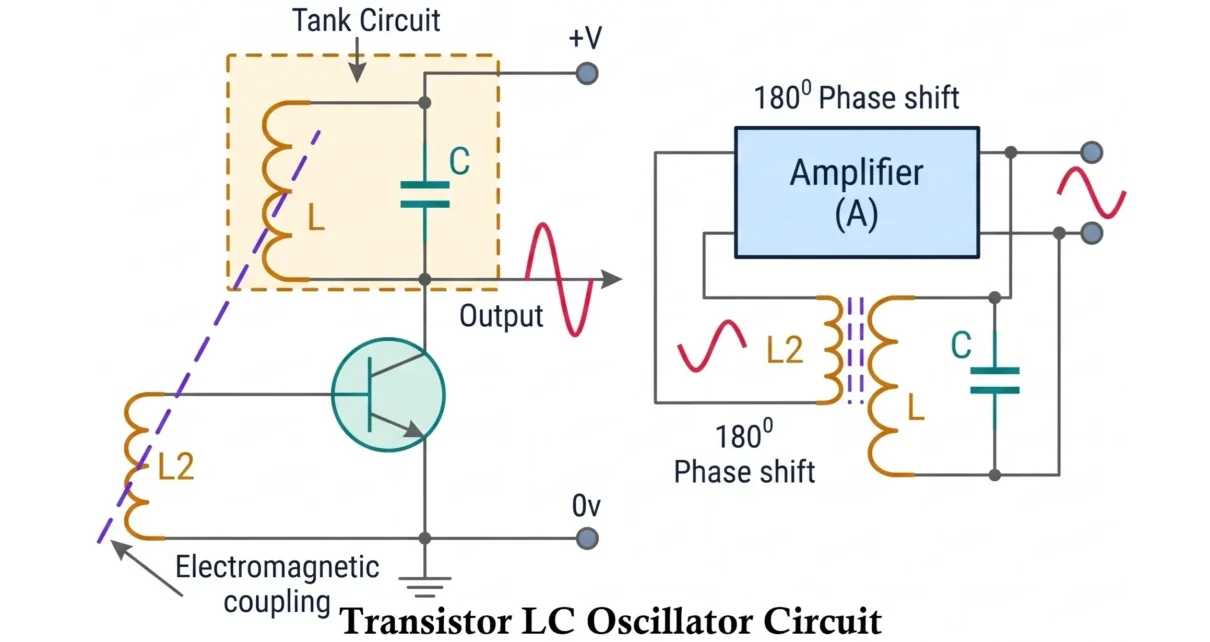
An LC oscillator is an electronic oscillator circuit that uses an inductor (L) and a capacitor (C) to generate continuous sinusoidal oscillations. These two components form a frequency-selective network known as an LC tank circuit, tuned circuit or resonant circuit. The tank circuit determines the oscillation frequency through the energy exchange between its electric and […]
Active components
Crystal Oscillator: Circuit Diagram, Working Principle, Types, and Applications
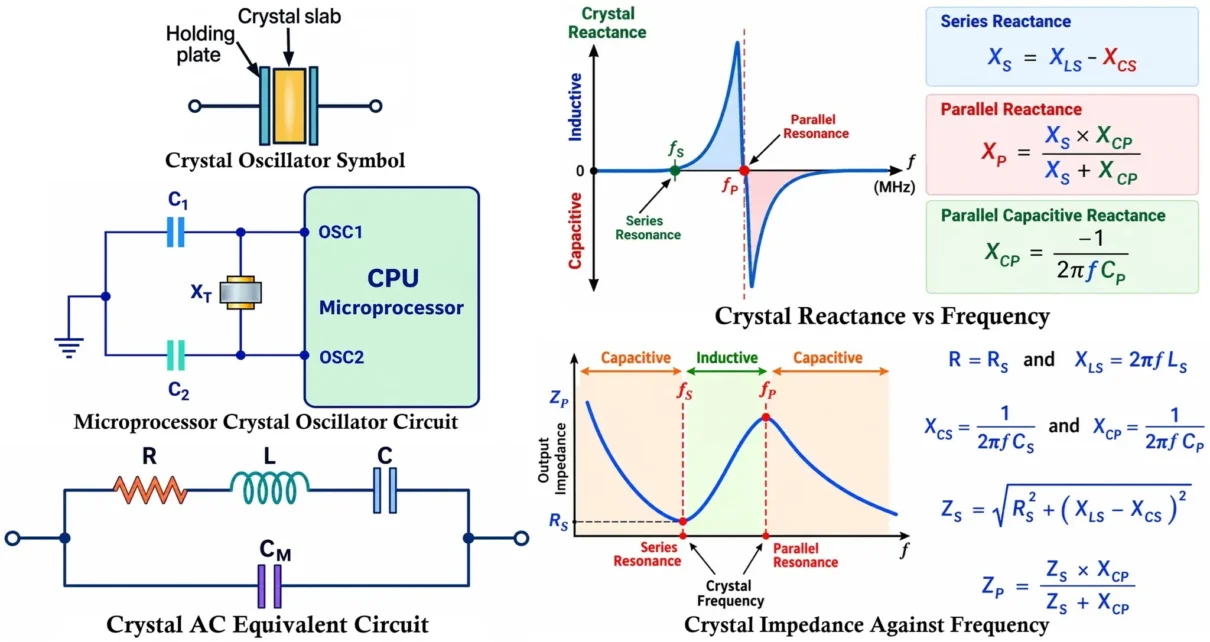
A crystal oscillator is an electronic circuit that uses the mechanical resonance of a piezoelectric crystal, usually quartz, to generate a stable periodic electrical signal. It is widely used in microcontrollers, microprocessors, digital clocks, communication systems, frequency counters, and electronic instruments that require accurate timing. Compared with conventional RC and LC oscillators, a crystal oscillator […]
Clapp Oscillator Circuit Diagram, Working and Applications
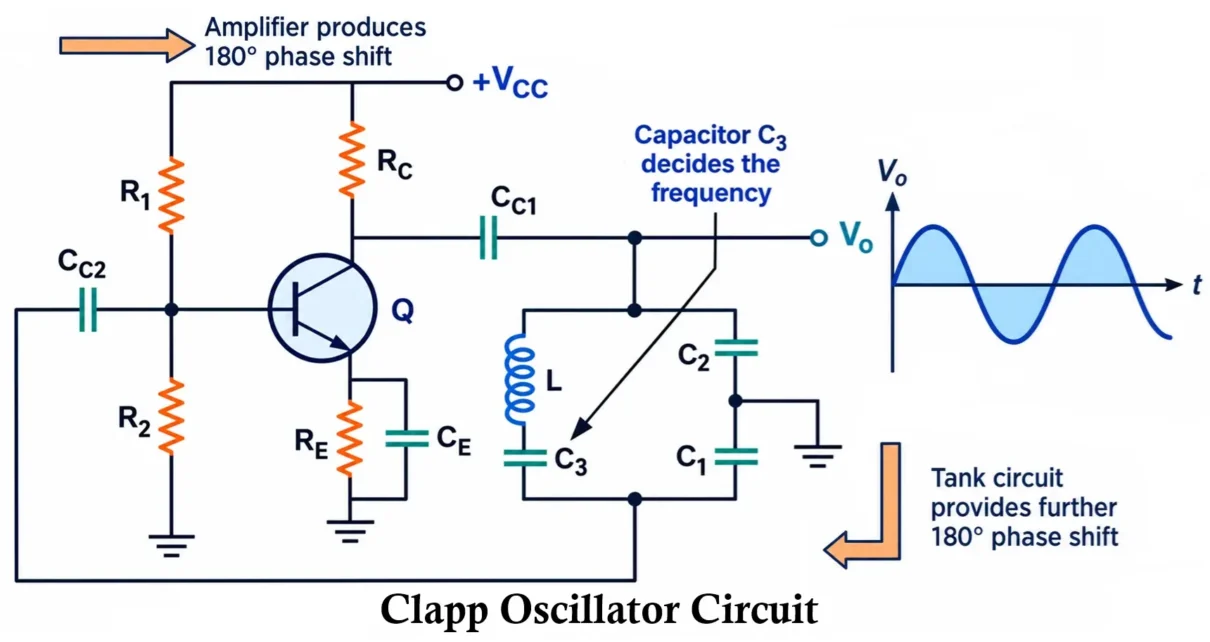
The Clapp oscillator is an LC electronic oscillator used to generate sinusoidal signals with good frequency stability. It is a modified version of the Colpitts oscillator, designed to reduce the influence of transistor junction capacitances and stray capacitances on the oscillation frequency. The main difference between a Clapp oscillator and a Colpitts oscillator is the […]
Colpitts Oscillator Circuit Diagram, Working and Applications
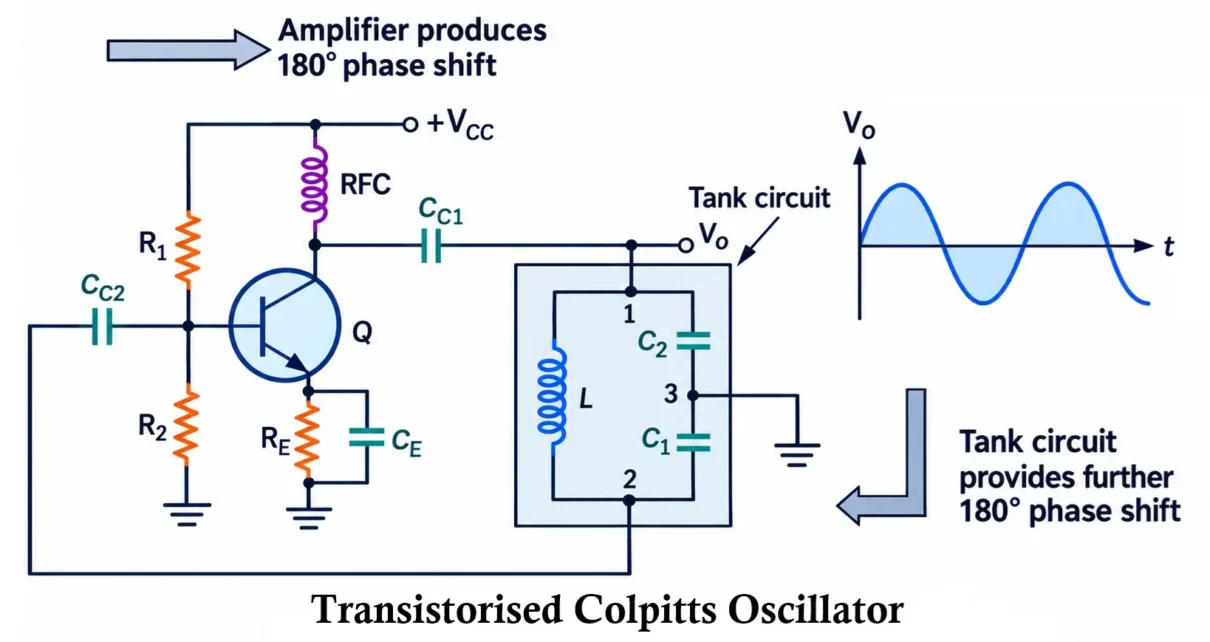
A Colpitts oscillator is an LC electronic oscillator that generates a continuous, approximately sinusoidal signal using an inductor and a capacitive feedback network. It is widely used in radio-frequency (RF) signal generation, communication equipment, local oscillators, and electronic experiments. Its defining feature is a capacitive voltage divider formed by two capacitors, C1 and C2, connected […]
Hartley Oscillator Circuit Diagram, Working and Applications
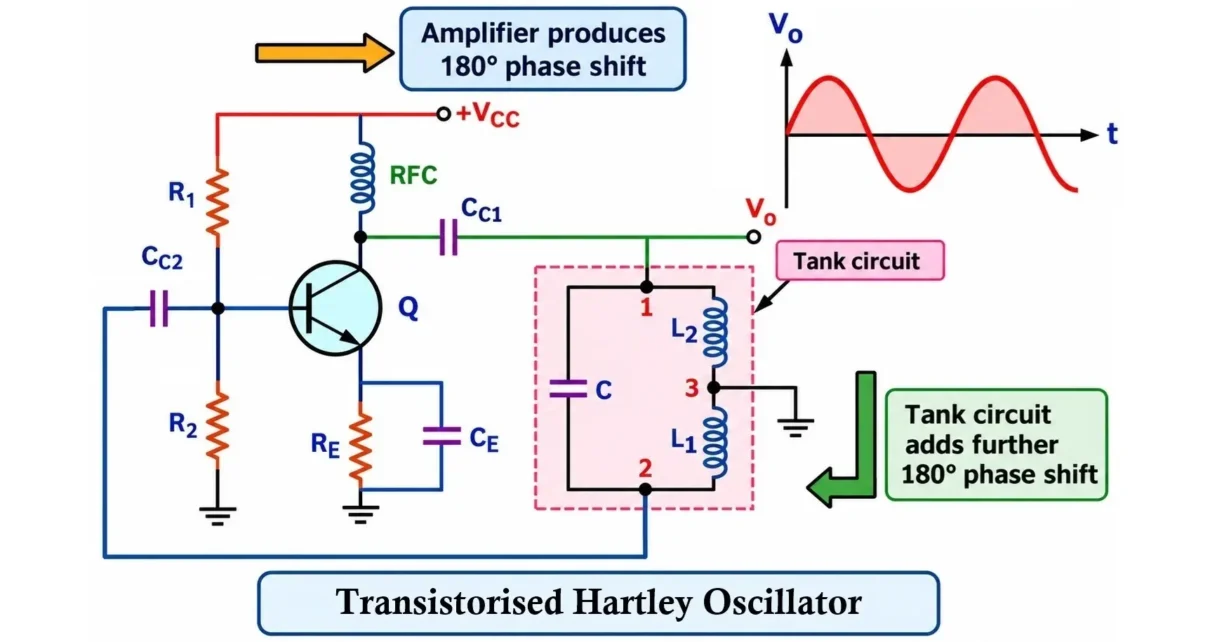
A Hartley oscillator is an LC sinusoidal oscillator that uses a capacitor and a tapped inductor or two series-connected inductors to form a resonant tank circuit. An active amplifier supplies the energy lost in the tank, while the inductive divider feeds part of the output signal back to sustain oscillations. The oscillator is commonly used […]
Types of Electronic Components Explained
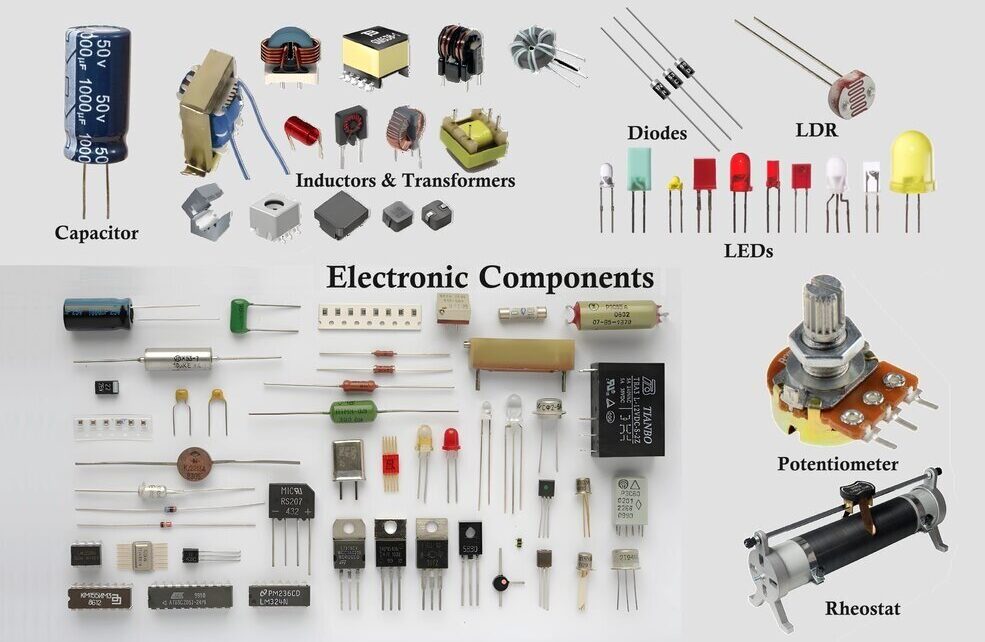
Electronic components are the fundamental building blocks of electronic circuits. Each component performs a specific task, such as controlling current, storing energy, processing signals, sensing changes in the environment, or supplying power. By combining these components on a printed circuit board (PCB), designers can build everything from simple LED circuits to computers, communication equipment, and […]